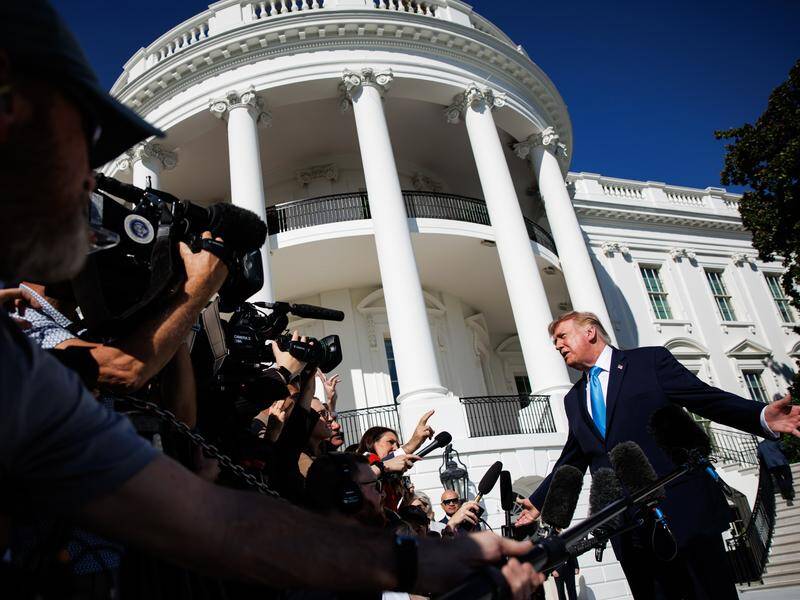
The investigation follows a temporary suspension of White House television pool coverage after the Trump administration revoked press credentials belonging to journalists from CNN, MS NOW and Politico.
The United States Department of Justice (DoJ) has launched an antitrust investigation into five major television networks over their decision to suspend pooled coverage of President Donald Trump following a dispute over White House press access.
The networks under investigation are ABC, CBS, CNN, NBC and Fox News. The Justice Department is examining whether their coordinated decision to halt coverage of presidential events violated federal competition laws, particularly the Sherman Antitrust Act.
According to the department, the investigation is intended to determine whether the networks breached laws prohibiting certain anti-competitive practices.
“Group boycotts among commercial competitors can violate the Sherman Act,” a Justice Department spokesperson said, adding that the Antitrust Division was investigating whether the news organizations had violated federal antitrust laws.
More Read

The investigation was first reported by The New York Times and comes amid escalating tensions between the Trump administration and major American news organizations. Reuters and other media outlets have also reported on the development.
Dispute Over White House Press Access
The controversy began in September after the Trump administration withdrew the White House press credentials of journalists from CNN, MS NOW and Politico.
More Read

President Trump had accused the organizations of publishing false or misleading reports about his administration. The affected media outlets challenged the decision, arguing that restricting their access because of their reporting violated their constitutional rights.
In response to the restrictions, the five television networks temporarily suspended their pooled coverage of the president in solidarity with the excluded organizations.
The decision disrupted the established system through which broadcasters take turns covering presidential appearances and distribute footage to other media organizations.
The networks’ collective action has now become the focus of the Justice Department’s investigation, which seeks to establish whether their decision amounted to an unlawful group boycott under federal competition law.
What Is the Sherman Act?
The Sherman Antitrust Act is a longstanding United States federal law designed to protect competition and prohibit certain anti-competitive agreements and monopolistic business practices.
Although the law is commonly associated with preventing companies from restricting competition in commercial markets, the Justice Department’s investigation raises questions about how antitrust principles apply when competing media organizations jointly decide not to provide a service.
More Read

The central issue is whether the networks’ temporary suspension of coverage constituted unlawful coordination under the law.
However, the opening of an investigation does not establish that any of the broadcasters violated the law. That determination would depend on the evidence and any subsequent legal proceedings.
Court Orders Reinstatement of Journalists’ Credentials
The press-access dispute also resulted in legal action against the Trump administration.
CNN, MS NOW and Politico challenged the restrictions in court, arguing that the government’s decision infringed their First Amendment rights.
The First Amendment to the US Constitution protects freedom of the press and restricts government actions that unlawfully interfere with that freedom.
On September 24, US District Judge Timothy Kelly ordered the administration to restore the affected journalists’ White House access after finding that the restrictions were likely unconstitutional.
Nevertheless, disputes over access to particular presidential events and assignments reportedly continued after the reinstatement of credentials.
The case has therefore developed on two legal fronts: the media organizations’ challenge to the administration’s restrictions and the Justice Department’s separate investigation into the broadcasters’ collective response.
Wider Tensions Between Trump and the Media
The latest investigation follows other disputes between the Trump administration and news organizations over reporting, access and editorial decisions.
Earlier in 2026, the White House announced that it was taking control of the presidential press pool arrangements, which had traditionally been managed by the White House Correspondents’ Association.
The administration also restricted Associated Press reporters and photographers from certain limited-access presidential spaces after objecting to the news agency’s continued use of the name “Gulf of Mexico” rather than “Gulf of America”.
The Associated Press challenged that restriction in court, arguing that the government should not penalize a news organization over its editorial language.
These disputes have intensified public debate about the relationship between government authority, media independence, competition law and the constitutional protection of journalism in the United States.

Television Networks Yet to Respond Fully
As the investigation develops, the five broadcasters face questions about the circumstances surrounding their decision to suspend pooled coverage and whether their actions complied with federal law.
The Justice Department has not established a violation, and the networks have not issued a collective public response to the investigation.
The outcome could have implications for the relationship between competing broadcasters, the operation of shared press-pool arrangements and the boundaries between commercial competition and collective action in defence of journalistic access.
For now, the investigation remains ongoing, with the central question being whether the networks’ temporary withdrawal from presidential coverage crossed the legal line between a collective protest and an unlawful agreement among competitors.