ILORIN, Nigeria — Fresh controversy has erupted over Nigeria’s political future following the Igbo Leaders of Thought (ILT)’s rejection of the communiqué issued at the Abuja restructuring conference of August 20, 2026, with political leaders and socio-cultural organisations across the South-West and northern Nigeria expressing sharply divided views on the proposed restructuring of the country.
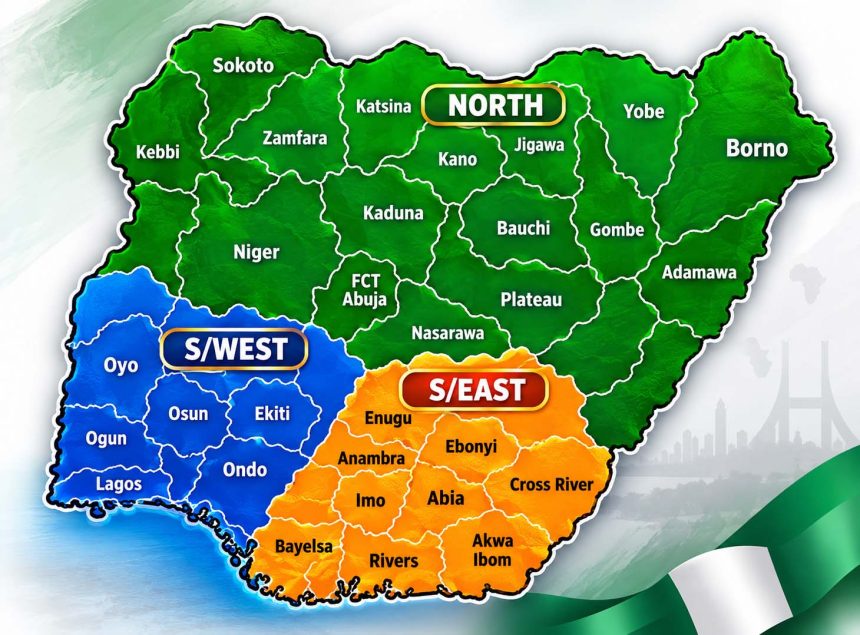
The ILT has proposed a 10-region political structure for Nigeria, with regional control of natural resources and regional police. The group has also called for the temporary suspension of the 2027 general elections until the restructuring exercise is completed and a new constitutional arrangement is put in place.
The proposal has reignited the national debate over fiscal federalism, resource control, decentralized policing, regional autonomy, minority rights and the future of Nigeria’s existing 36-state structure.
While some stakeholders believe the country urgently needs a new political arrangement to address longstanding structural problems, others have questioned the practicality of the proposed regional system, warning that it could create fresh divisions and undermine democratic stability.
South-West Leader Describes ILT Proposal as Unrealistic
Mogaji Gboyega Adejumo, who led the South-West delegation to the Patriots Constitutional Conference in Abuja, described the ILT’s position as unrealistic, arguing that Nigeria’s various ethnic groups had yet to reach a clear consensus on the country’s future political arrangement.
More Read
Adejumo maintained that the restructuring debate was not new, recalling earlier political and constitutional efforts to address Nigeria’s structural challenges, including the Action Group government’s initiatives in the 1950s and subsequent constitutional conferences.
He argued that the South-West’s position on restructuring was not fundamentally different from some of the demands being advanced by the Igbo, but questioned whether the various groups had developed a practical and coordinated approach to achieving their objectives.
According to him, Nigeria’s constituent groups need to examine the basis of their union and negotiate a workable political arrangement rather than pursue competing interests.
More Read

Adejumo also called for dialogue among the country’s major ethnic and regional groups, stressing that any lasting solution must emerge from negotiations and mutual understanding.
He cautioned that separation would not automatically guarantee peace, stability or economic prosperity, citing the experiences of countries that continued to face conflict after separation.
Afenifere Rejects Regionalism, Cites Minority Concerns
The pan-Yoruba socio-political organization, Afenifere, also rejected the proposed regional arrangement, insisting that it remained committed to the resolutions of the 2014 National Conference.
The organization’s National Publicity Secretary, Justice Faloye, argued that imposing regions from the federal level could create political instability, particularly in the South-South and North-Central regions, where several ethnic minorities could be affected by decisions over regional boundaries.
Faloye said Nigeria’s numerous ethnic nationalities made it necessary to adopt a restructuring process that protects the interests and political rights of all communities.
He maintained that communities should be allowed to determine their preferred political and administrative affiliations through a bottom-up process rather than being assigned to regions without their consent.
More Read
According to him, states sharing similar ethnic identities should be free to merge into regions if their populations approve the arrangement, while communities should also have the opportunity to seek affiliation with neighboring states through an agreed process.
Afenifere’s Secretary-General, Chief Ademola Folarin, similarly said the organization was not part of the Abuja conference and had not abandoned its position on the 2014 National Conference resolutions.
Folarin said the conference had supported the retention of the federal and state structure, with the possibility of creating additional states to accommodate minority interests.
He added that the conference also recommended devolving more powers to states, including responsibilities relating to policing, mining and local government administration.
Omololu Backs Restructuring Through Consent
However, the Convener of the Conscience of Yoruba Nation Group, Apagun Kole Omololu, expressed support for restructuring Nigeria into autonomous regions within a voluntary and inclusive federal system.
Omololu argued that any new political arrangement must be based on the freely expressed consent of the communities concerned, warning that restructuring must not replace one form of domination with another.
He said historical concerns about the rights of minority nationalities, including those examined by the Willink Commission in 1957, should inform the current debate.
According to him, communities must have confidence that their identities, languages, cultures, political rights and legitimate economic interests will be protected under any proposed regional structure.
Omololu urged the Igbo Leaders of Thought to engage the states and communities they wish to include in their proposed Igbo Region and obtain their consent.
He maintained that the central questions should concern who decides regional affiliation, whether proposed boundaries are viable, whether the affected communities agree to the arrangement and what constitutional safeguards would protect minorities.
He also welcomed further dialogue among groups committed to restructuring, describing an inclusive and citizen-driven constitutional process as essential to building a more equitable federation.
CACOL Warns Against Creating a Democratic Vacuum
The National Chairman of the Centre for Anti-Corruption and Open Leadership (CACOL) and President of the Committee for the Defence of Human Rights (CDHR), Mr Debo Adeniran, said the controversy exposed the absence of a national consensus on what Nigeria’s restructured political system should look like.
Adeniran argued that the rejection of the Abuja communiqué by the ILT should not be dismissed as another ethnic disagreement, but treated as a reminder that constitutional reform requires genuine consultation and the consent of the people concerned.
He noted that the proposed 10-region structure, particularly the enlarged Igbo Region extending beyond the five South-East states, raised important questions about boundaries, community preferences and minority rights.
He called for transparent dialogue and, where necessary, referendums to resolve disputes over proposed regional arrangements.
However, Adeniran expressed concern over the proposal to suspend the 2027 general elections, warning that such a move would have serious constitutional and democratic implications.
He said any transition involving a change in the political structure would require a clear legal framework, broad national agreement, a defined timetable and safeguards against an indefinite transitional arrangement.
According to him, restructuring should strengthen democracy rather than create another governance crisis.
Yoruba Council Worldwide Calls for National Dialogue
The President of the Yoruba Council Worldwide, His Royal Majesty, Aare Sooko Oladotun Hassan, argued that Nigeria had reached a critical point in its political history and could no longer continue to postpone the restructuring debate whenever elections approached.
Hassan said the country needed a fairer federal arrangement that would give its constituent regions greater responsibility for their development priorities, economic resources and security challenges.
He supported open debate on the ILT’s 10-region proposal, including regional resource control and decentralized policing, while emphasizing the need for constitutional safeguards to prevent political intimidation, ethnic persecution and the marginalization of minority communities.
He also urged caution over the proposal to suspend the 2027 elections, insisting that electoral democracy and restructuring should not be treated as mutually exclusive priorities.
Hassan called on President Bola Ahmed Tinubu, the National Assembly, political parties, traditional rulers and socio-cultural organizations to establish an inclusive platform for negotiations.
He maintained that Nigeria’s restructuring debate should be treated as a national issue rather than the exclusive agenda of any ethnic nationality.
Arewa Consultative Forum Questions Constitutionality of Election Suspension
The spokesperson for the Arewa Consultative Forum (ACF), Professor Tukur Baba, rejected the proposal to postpone the 2027 general elections, arguing that electoral postponement must be consistent with the provisions of the Nigerian Constitution.
Baba maintained that no ethnic or regional organization had the authority to halt the country’s electoral process or compel the federation to adopt a particular restructuring arrangement.
He said the constitutional review process had already involved the National Assembly and state assemblies, adding that the details of the National Assembly’s position had not been made public at the time of his comments.
According to him, any proposal for restructuring should be channeled through constitutional institutions, including state assemblies and the National Assembly.
Baba also disclosed that the ACF had submitted recommendations during the constitutional review process, including proposals concerning the constitutional framework governing the federation.
He stressed that, regardless of the perceived shortcomings of the existing Constitution, reforms must be pursued through negotiation, consultation and constitutionally recognized procedures.
OPC Condemns Call to Suspend Elections
The Oodua People’s Congress (OPC) Worldwide also criticized the ILT’s proposal, describing the call to suspend the 2027 elections as unacceptable.
The organization’s Deputy National Secretary, Otunba Babatunde Thompson, questioned the rejection of the existing six geopolitical zones, arguing that the framework had become widely accepted as an administrative basis for organizing Nigeria’s states.
Thompson advocated resource control for the six geopolitical zones, with contributions made to the Federal Government, and called for a Sovereign National Conference to produce a constitution that reflects the aspirations of Nigerians.
He argued that a new constitutional arrangement should allow the different parts of the country to develop according to their needs and resources without oppression or unnecessary central control.
Nigeria’s Restructuring Debate Enters a Critical Phase
The differing reactions highlight the divisions that continue to shape Nigeria’s restructuring debate.
While several stakeholders agree on the need to address the country’s centralized political and security arrangements, they remain divided over whether restructuring should be based on autonomous regions, the existing state structure or a combination of both.
The question of minority protection has also emerged as a major point of contention, particularly over how regional boundaries would be determined and whether communities would have the freedom to choose their political affiliations.
The proposed suspension of the 2027 general elections has further complicated the debate, with several leaders warning that constitutional reform must not come at the expense of democratic rights.
As discussions continue, stakeholders are calling for inclusive negotiations that accommodate the interests of Nigeria’s diverse ethnic nationalities and communities.
The central challenge remains how to build a political arrangement that promotes regional development, equitable resource distribution, effective security, minority protection and national stability without undermining constitutional democracy.
Whether the competing proposals can be reconciled through dialogue and constitutional reform remains a major question for Nigeria’s political leadership as preparations for the 2027 general elections continue.