Authorities confirm dozens rescued as raging waters damage a hydropower project and force families to flee their homes in central Nepal.
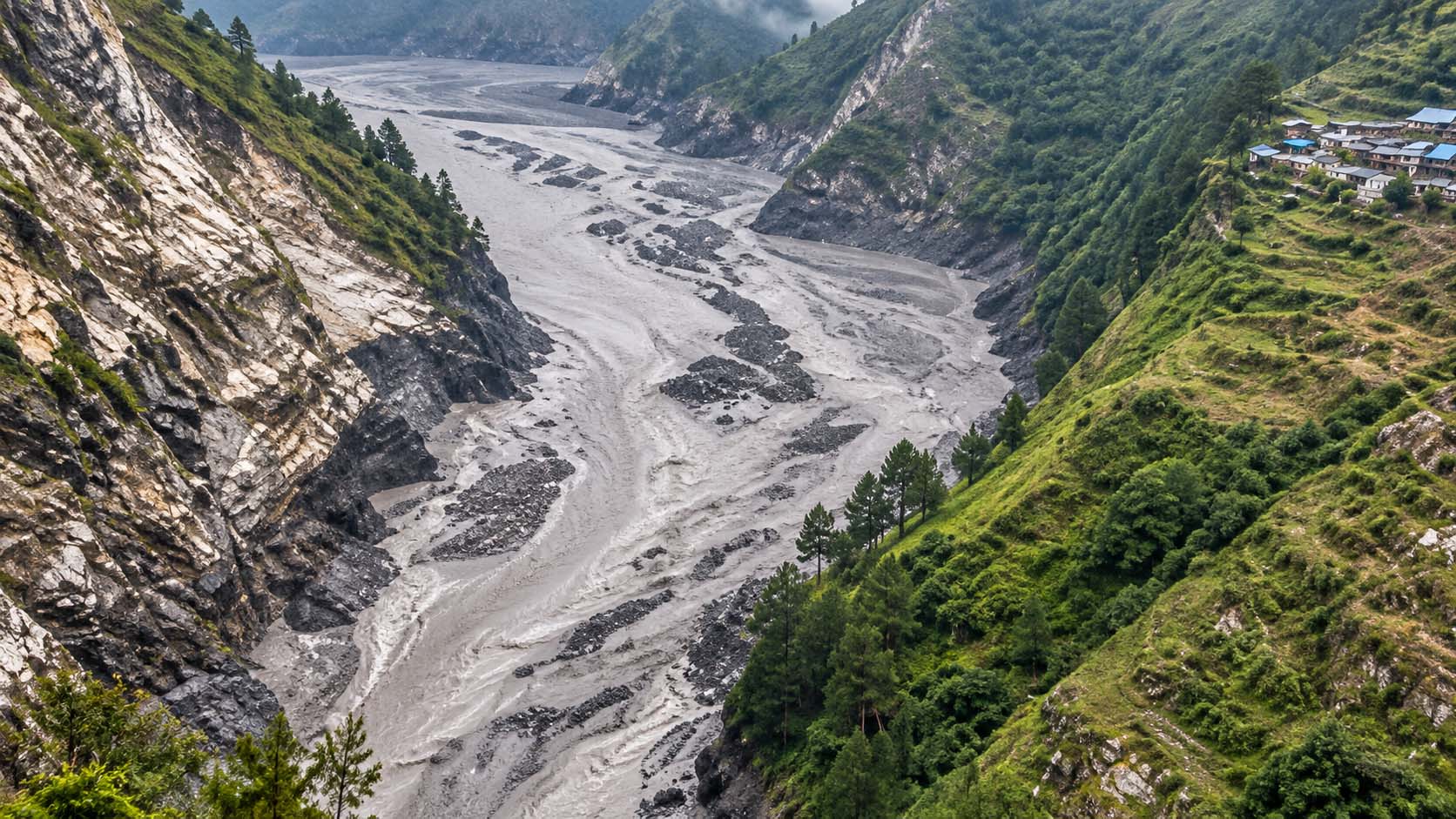
A devastating flood along Nepal’s Budhi Gandaki River has swept away houses and suspension bridges, damaged a hydropower project and left at least five people missing, according to authorities.
The flooding occurred in the central Gorkha district, where the Nepalese army confirmed that around 50 people had been rescued from areas along the riverbank. No casualties had been reported at the time of the announcement, although rescue and assessment efforts were continuing.
Dramatic video footage of the incident shows powerful torrents of water rushing down a valley and sweeping away an entire building complex, highlighting the destructive force of the flood.
More Read

River Levels Rise Sharply Within Hours
According to officials, the river’s water level at one monitoring location rose from approximately two metres to nearly 8.5 metres within a few hours, raising concerns about the scale and speed of the flooding.
The National Disaster Risk Reduction and Management Authority reported that about a dozen houses and several suspension bridges were swept away. A hydropower project under construction was also damaged, with some construction equipment carried away by the floodwaters.
The disaster further disrupted monitoring activities after a hydrological station was swept away.
More Read

Binod Parajuli, a meteorologist working with the Nepalese government, said the loss of the station had left officials without crucial data from the affected location.
The absence of monitoring information could complicate efforts to assess river conditions and determine the full extent of the flooding.
Cause of the Flood Remains Unclear
The exact cause of the latest disaster has not been established, with different explanations being considered by observers and experts.
One possibility is that a landslide temporarily blocked the river or one of its tributaries, creating a natural dam. If the accumulated water subsequently broke through the obstruction, it could have unleashed a sudden surge downstream.
Another account suggests that residents upstream witnessed an ice avalanche, although the circumstances surrounding the reported event remain unclear.
Experts have indicated that the debris flow associated with this incident was considerably smaller and moved more slowly than the catastrophic flash floods that struck the region in August.
More Read

Further investigation will be needed to establish what triggered the flooding and whether additional hazards remain in the affected area.
Families Displaced as Children Face Renewed Trauma
The disaster has forced families to abandon their homes, leaving many uncertain about where they will find safe shelter, food and other essential supplies.
The timing has added to the distress, as communities and children were preparing to mark the beginning of Dashain, one of Nepal’s most significant annual festivals.
The latest flooding has also raised concerns about the psychological and social impact on children who may still be recovering from previous flood disasters.
Save the Children said it was mobilizing an emergency response team to support those affected by the incident.
Tara Chettry, the organization’s director in Nepal, expressed concern about the impact on children and their communities.
She warned that many children could have lost their homes, schools and familiar support networks, adding that the full extent of the damage was yet to be determined.
Chettry also noted that children in Gorkha could still be experiencing shock and distress following the major floods in August, leaving them particularly vulnerable to another emergency.
Nepal Faces Continued Flood and Landslide Risks
The latest incident comes as Nepal continues to grapple with the consequences of earlier catastrophic flooding that affected communities near its border with Tibet.
The previous disaster reportedly left more than 1,400 people dead and thousands missing, causing widespread destruction and placing enormous pressure on emergency responders and affected families.
The Budhi Gandaki River is a tributary of the Trishuli River. The wider river system has been associated with severe flooding events, including a previous disaster linked to a glacier collapse upstream.
Nepal’s mountainous terrain makes some communities vulnerable to sudden floods, landslides and debris flows, which can develop rapidly and damage roads, bridges, homes and critical infrastructure.
The latest flooding underscores the importance of effective early-warning systems, reliable river monitoring and rapid emergency response, particularly in communities located along vulnerable river valleys.
Emergency Response and Damage Assessment Continue
With five people reported missing and homes and infrastructure destroyed, attention remains focused on locating those unaccounted for, supporting displaced residents and determining the full extent of the damage.
The loss of the hydrological monitoring station has created an additional challenge for officials attempting to track river conditions.
Authorities and humanitarian organizations will need to assess immediate shelter requirements, access to essential supplies and the longer-term needs of affected families.
Until the cause of the flood is confirmed and the damage assessment completed, uncertainty remains over the full impact of the disaster on communities in Gorkha district.