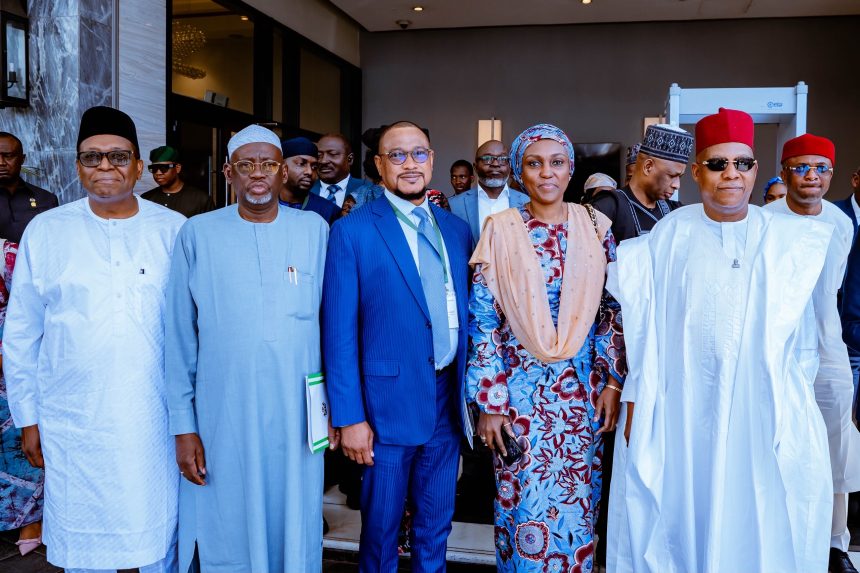
The Federal Government and state governments are stepping up efforts to combat child malnutrition and stunting across Nigeria through the Nutrition 774 Initiative, adopting lessons from Ethiopia’s nutrition programme to strengthen interventions at the grassroots.
The initiative seeks to extend nutrition interventions to all 774 local government areas, wards, communities and households across the country through coordinated action in healthcare, education, agriculture, water, sanitation and social protection.
The Coordinating Minister of Health and Social Welfare, Professor Muhammad Ali Pate, disclosed this during the Nigeria-Ethiopia Nutrition Leadership Exchange in Addis Ababa, Ethiopia, where the Nigerian delegation is led by Vice President Kashim Shettima.
Pate said the exchange would enable both countries to develop a roadmap based on lessons learned from Ethiopia’s experience, with the aim of improving implementation and accelerating progress in tackling malnutrition.
According to him, nutrition remains central to human capital development and requires a coordinated approach involving government institutions, communities and other stakeholders.
More Read

“Nutrition is key to human capital development, and it requires sectors to work together in a whole-of-government and whole-of-society approach,” he said.
The minister acknowledged that Nigeria had recorded progress through national interventions and community-based programmes but stressed the need to strengthen implementation to achieve more significant results.
“We have to now go back and deepen the progress, accelerate,” Pate said, expressing optimism that sustained efforts over the next four to five years would produce meaningful improvements, particularly in the health and well-being of children.
More Read

Nutrition 774 Initiative Targets Grassroots Communities
Jigawa State Governor, Umar Namadi, said the success of the Nutrition 774 Initiative would depend largely on its ability to reach individual households rather than remain confined to policies developed at the national and state levels.
He emphasised that the programme must be implemented across every level of government and extended directly to communities where families experience nutrition-related challenges.
“The one thing that is very important with 774 is the fact that it will have to go down from the national level to each local government, each ward, each community and each household,” Namadi said.
The governor highlighted Jigawa State’s efforts to complement federal interventions with locally developed programmes, including the Masaki initiative and a Tom Brown nutrition programme.
According to him, about 600 women have been trained to produce nutritious food for children as part of efforts to improve household nutrition and promote community participation.
The initiative reflects the importance of equipping families, particularly women and caregivers, with practical knowledge and skills to prepare nutritious meals for children.
More Read

Insecurity Worsens Nutrition Challenges in Zamfara
Zamfara State Governor, Dauda Lawal, identified insecurity as a major factor worsening nutrition challenges in his state, explaining that the disruption of agricultural activities had affected communities that previously produced enough food to feed their populations.
He said the state’s changing circumstances had made nutrition a more pressing concern, requiring additional measures to protect vulnerable households.
“In the past, when you spoke about nutrition, we didn’t even have anything like that in the state because we produced enough to feed our people. However, because of those challenges now, it has become difficult,” Lawal said.
The governor said his administration would continue exploring solutions while aligning with Federal Government programmes and adapting interventions to the realities of communities affected by insecurity.
“Should we be defined by the insecurity? The question is no. What else can we do?” he asked.
His remarks highlighted the relationship between security, agricultural production, household food access and the ability of families to provide adequate nutrition for children.
Governors Call for Greater Attention to Vulnerable Groups
Osun State Governor, Ademola Adeleke, said children under five and pregnant women must receive particular attention in efforts to improve nutrition outcomes.
He acknowledged that Nigeria had made progress but maintained that further improvements were necessary. He also expressed confidence that the Nigeria-Ethiopia exchange would provide an opportunity for Nigerian officials to learn from approaches adopted in Ethiopia.
Similarly, Abia State Governor, Alex Otti, called for greater willingness to learn from countries that had made progress in addressing malnutrition rather than attempting to develop every solution from scratch.
“There’s nothing wrong with saying that we have not done as well. And there’s also nothing wrong in learning from those who have done it, so that you don’t go reinventing the wheel,” Otti said.
He stressed that nutrition should not be treated solely as a food security issue, noting that healthcare, education, agriculture, climate change and poverty reduction are interconnected areas that require coordinated interventions.
Otti also highlighted investments in education in Abia State, including the recruitment of 9,469 teachers, the development of 20 smart schools and the rehabilitation of more than 200 primary and secondary schools.
He further noted the state’s commitment of about 20 per cent of its annual budget to education, underscoring the importance of education in broader human development efforts.
Education and Early Childhood Development Central to Nutrition Agenda
The Minister of Education, Dr Maruf Tunji Alausa, said nutrition interventions must begin during pregnancy and continue through the critical early years of a child’s development.
He warned that failing to address children’s nutritional and developmental needs during this period could have lasting consequences for their future well-being and opportunities.
“If we miss that period, the 2,000 days, we’ve set those children up for failure in life,” Alausa said.
The minister explained that the Nutrition 774 agenda was designed to move interventions from the Federal Government through state and local governments to communities, ensuring that programmes reach the people who need them.
His remarks reinforced the importance of integrating nutrition into maternal healthcare, early childhood development, education and community-level support systems.
Safe Water and Sanitation Identified as Key Priorities
The Minister of Water Resources and Sanitation, Professor Joseph Utsev, also emphasised the importance of safe water, sanitation, irrigation and agricultural production in improving nutrition outcomes.
He explained that access to reliable water supplies was necessary not only for drinking and sanitation but also for food production and healthy living.
Utsev noted that improved access to water and sanitation could support better health outcomes while helping communities strengthen agricultural activities and food availability.
His position highlights the need for nutrition interventions to go beyond food distribution and address environmental and public health conditions that influence the health and well-being of families.
Nigeria and Ethiopia to Develop Nutrition Roadmap
The Nigeria-Ethiopia Nutrition Leadership Exchange is expected to inform the development of a roadmap to improve coordination among government institutions and strengthen the delivery of nutrition interventions across Nigeria.
By drawing lessons from Ethiopia’s experience, Nigerian officials are seeking approaches that can be adapted to the country’s different social, economic, agricultural and security conditions.
The Nutrition 774 Initiative places local governments, wards, communities and households at the centre of efforts to translate national policies into practical interventions.
Its success will depend on effective coordination among government agencies, sustained implementation, adequate resources and the ability to reach vulnerable populations, particularly children under five, pregnant women and families facing food insecurity.
As Nigeria intensifies efforts to address malnutrition and childhood stunting, the central challenge will be ensuring that commitments made at national and state levels translate into measurable improvements in nutrition, child development and family well-being across all 774 local government areas.
For millions of Nigerian families, the impact of the initiative will ultimately be measured not only by the policies introduced but also by whether children have consistent access to nutritious food, essential healthcare, safe water and the conditions needed to grow and thrive.