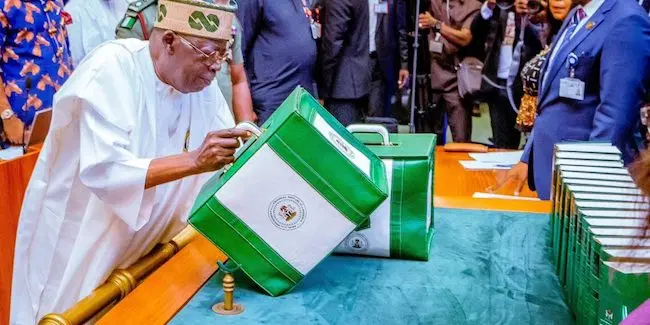
ABUJA — The Federal Government’s 2026 capital budget is facing the prospect of another major roll-over as the implementation of billions of naira in capital projects from previous fiscal years remains significantly below expectation.
There are growing indications that a substantial portion of the Federal Government’s capital expenditure allocation for 2026 may not be implemented before the end of the fiscal year, raising the possibility of another extension of outstanding capital projects into subsequent budget years.
A senior official of the Budget Office of the Federation (BOF), who spoke with Financial Vanguard in Lagos, reportedly acknowledged the situation, saying the outstanding allocations would be rolled over because such extensions had become a normal practice.
Findings from several Ministries, Departments and Agencies (MDAs) indicate that the Federal Government is still grappling with outstanding capital releases from the 2024 and 2025 budgets, with releases in many agencies reportedly remaining below 50 per cent.
The development means that billions of naira in appropriated capital expenditure could again be carried forward, adding to the existing backlog of unfinished projects and financial obligations.
More Read
N16.8 trillion carried into 2026
The Federal Government and the National Assembly have already approved the roll-over of approximately N16.8 trillion in capital expenditure appropriated under the 2024 and 2025 budgets into the 2026 fiscal year.
The extension, initially expected to run until June 2026, was later extended to September 30, 2026, following concerns over the slow pace of implementation.
The N16.8 trillion carried-over allocation represents a significant portion of the N32.3 trillion capital expenditure provision for 2026.
More Read

Consequently, only about N15.5 trillion of the 2026 capital allocation represents new expenditure, while the remaining amount is tied largely to outstanding obligations from previous budget years.
This has raised concerns that the 2026 budget could effectively become another vehicle for settling unfinished obligations rather than financing entirely new infrastructure and development projects.
House raises concerns over implementation
The House of Representatives Committee on Appropriations has repeatedly raised concerns about the government’s inability to fully implement appropriated capital expenditure.
Chairman of the committee, Abubakar Bichi, disclosed during proceedings that approximately N16.765 trillion had been stripped from previous capital allocations and rolled into the 2026 fiscal year because of funding constraints.
The committee had reportedly engaged key officials, including former Minister of Finance and Coordinating Minister of the Economy, Wale Edun, Minister of Budget and Economic Planning, Atiku Bagudu, and Director-General of the Budget Office, Tanimu Yakubu, in an attempt to establish why approved funds had not been released.
By April 2026, as the National Assembly considered the N68.323 trillion 2026 budget, the Appropriations Committee confirmed that roughly N32 trillion had been earmarked for capital expenditure through the Development Fund.
More Read

Part of the increase over the Executive’s original N58.47 trillion proposal was reportedly intended to regularise outstanding capital obligations inherited from 2025 and ensure that contractors were paid for completed projects.
The situation effectively means that a significant portion of the 2026 budget was designed to address unfinished financial commitments from previous years.
House extends capital budget deadline
The implementation crisis resurfaced in June when the House of Representatives approved an extension of the lifespan of the 2025 capital budget from June 30 to September 30, 2026.
Majority Leader of the House, Julius Ihonvbere, said substantial funds released to MDAs remained unspent because of administrative bottlenecks, procurement delays and other implementation challenges.
Speaker Tajudeen Abbas also supported the extension, citing records indicating that the capital budget had not been fully implemented.
The latest extension has further intensified concerns over whether the Federal Government will be able to execute the outstanding capital projects before the September deadline.
Health sector records dramatic shortfall
The extent of the implementation problem became particularly evident during a 2026 budget defence session before the House Committee on Healthcare Services.
The Coordinating Minister of Health, Prof. Muhammad Ali Pate, disclosed that out of the N218 billion appropriated for the ministry’s capital projects and programmes in 2025, only N36 million had been released.
That represented approximately 0.02 per cent of the capital allocation.
Even more concerning, Pate reportedly told lawmakers that the N36 million released had not been utilised.
The minister attributed the situation partly to the Bottom-Up Cash Plan operated through the Office of the Accountant-General of the Federation, while also pointing to delays in counterpart funding that affected some donor-supported health programmes.
The chairman of the committee, Hon. Amos Gwamna Magaji, subsequently directed the ministry to provide detailed documentation on donor funds received and how they had been utilised.
Several ministries receive less than 2 per cent
Disclosures from other ministries during the 2026 budget defence sessions also revealed significant disparities between appropriated capital funds and actual releases.
The Ministry of Women Affairs, for instance, reportedly received only N394.8 million out of an N89.8 billion capital allocation, representing about 0.44 per cent.
The Ministry of Marine and Blue Economy received approximately N202 million from its N353 billion capital allocation, while the Ministry of Transportation received N2.5 billion out of N256.7 billion.
Similarly, the Ministry of Housing and Urban Development reportedly received N2 billion from an allocation of N100 billion, while the Ministry of Water Resources received approximately N1 billion from N80 billion.
The Ministry of Agriculture and Food Security received about N3 billion from a capital allocation of N120 billion.
Across eight ministries reviewed, only about N9.13 billion had reportedly been released out of a combined capital allocation of approximately N1.218 trillion, representing just 1.3 per cent.
Public Accounts Committee threatens sanctions
The House Committee on Public Accounts has also expressed concern over the failure of several government agencies to properly account for public funds.
In February 2026, following an investigative hearing, the committee recommended that 22 MDAs be excluded from the 2026 budget process over their failure to respond adequately to audit queries and provide required financial records.
Among the agencies affected were the Nigerian Meteorological Agency, Federal Housing Authority, Standards Organisation of Nigeria, National Insurance Commission and National Business and Technical Examinations Board.
Committee Chairman, Hon. Bamidele Salam, said repeated invitations and directives had gone unanswered.
Several agencies were also accused of failing to submit audited financial statements for periods ranging from three to five years or more.
The committee relied on provisions of the Financial Regulations 2009 and the constitutional oversight powers of the National Assembly in making its recommendations.
Cash planning, debt and procurement blamed
Across the various committee hearings, government officials have cited several factors for the slow release and implementation of capital funds.
These include the Bottom-Up Cash Plan, revenue constraints, high debt-servicing obligations, delayed counterpart funding, procurement bottlenecks and administrative challenges within MDAs.
Minister of State for Finance, Doris Uzoka-Anite, reportedly told the Senate Appropriations Committee in February that payments for outstanding 2024 capital obligations were only beginning.
She also said the government’s financial management system was back online and that MDAs had been instructed to upload their cash plans before funds could be released.
The development suggests that the problem is not solely the availability of appropriated funds but also the mechanism through which cash is planned, approved and released to government agencies.
Another year of unfinished projects?
The recurring roll-over of capital expenditure has raised broader concerns about Nigeria’s budget implementation process.
While the National Assembly appropriates funds annually for infrastructure and development projects, the actual release of those funds has increasingly lagged behind the approved allocations.
President Bola Tinubu had earlier disclosed that, as of the third quarter of 2025, only N3.10 trillion, representing approximately 17.7 per cent of the 2025 capital budget, had been released.
At the same time, about N2.23 trillion had reportedly been released for outstanding 2024 capital projects under an earlier extension.
With the September 30, 2026 deadline approaching, attention is now focused on whether the Federal Government will be able to clear the accumulated backlog or whether another extension will become necessary.
The situation has also renewed questions about the effectiveness of Nigeria’s annual budgeting system, particularly whether appropriations can translate into actual projects when cash releases, procurement processes and accountability mechanisms remain constrained.
For lawmakers overseeing the implementation of the budgets, the recurring carry-over of capital expenditure represents a growing challenge.
Unless the bottlenecks surrounding cash releases, procurement and financial accountability are addressed, the 2026 budget could end with substantial portions of its capital allocation still tied to projects and obligations inherited from previous years.