


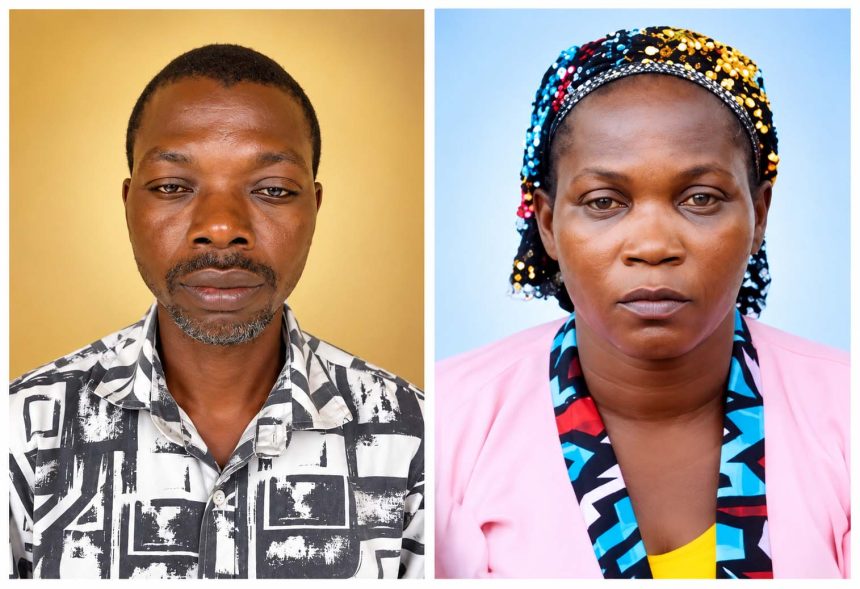
Despite losing their sight to measles, Michael and Akintomide Ogunkanmi have pursued education, built a family and held on to their dreams. But with no regular employment, the Lagos-based couple are struggling to provide for their three young children.
For Michael and Akintomide Ogunkanmi, the greatest challenge is not simply living with blindness. It is the daily struggle to feed their children, meet their educational needs and secure a stable future despite both parents having formal teaching qualifications.
The couple, who are both trained educators, have three children: an eight-year-old daughter, a five-year-old son and a three-year-old daughter. Although all three children can see, Michael says his eldest daughter has difficulty seeing objects at a distance.
At just eight years old, the eldest daughter is already learning to help with household chores, including washing plates, sweeping and occasionally cooking simple meals.
“She can wash plates and sweep,” Michael said proudly. “Sometimes she can cook rice or beans. Just little things like that.”
But beyond her growing responsibilities at home, the young girl has an ambitious dream of becoming a doctor, while her five-year-old brother hopes to become a lecturer.
For their father, these aspirations are a source of pride as well as anxiety, as he worries about how he and his wife will afford the education their children need to pursue their ambitions.
Living from uncertain income and borrowed food
Michael, who holds a Nigeria Certificate in Education (NCE) in Music and Special Education, has no regular employment. He currently relies largely on playing drums in a church to support his family.
Although he previously received N20,000 for his services, the payments are irregular. On some occasions, church members give him N1,000, N2,000 or N3,000 after he plays.
“That is what I use to manage,” he said.
With three children to feed and educate, however, the uncertain income is rarely enough to cover the family’s daily expenses.
Michael recounted occasions when his children returned from school to find no food at home, forcing him to seek assistance from neighbours or purchase food on credit.
“Sometimes, if they come back from school and there is no food, I will go outside and buy something on credit,” he said.
“I can buy biscuits for them just to take first. Sometimes one of our neighbours sells raw food, so I go there to buy on credit and later we pay.”
The family is also facing mounting expenses as the children prepare to return to school. Their needs include textbooks, sandals and additional school uniforms, but Michael says he currently has no money to purchase them.
“The school is about to resume. They need textbooks, sandals, and another school uniform. All those things, there is no money to get them for now,” he said.
Two qualified teachers still waiting for employment
The couple’s circumstances are particularly difficult given their educational backgrounds and their determination to work.
Michael’s wife, Akintomide, also holds an NCE, in Social Studies and Special Education. Both say they applied for teaching positions through the Lagos State Universal Basic Education Board (SUBEB) in July last year.
According to Michael, they were initially informed that they would be contacted. After waiting without receiving any response, they returned to make enquiries and were again asked to wait.
He said he was subsequently advised to obtain a recommendation letter, which he did and submitted. The couple say they still have the acknowledgement letter.
“The acknowledgement letter is still with us,” he said.
“They said they would call us. They have been calling some people, but up till now, since last year, they haven’t called us. We are still expecting that they will call us.”
For Michael, securing a teaching job would mean more than earning a monthly salary. It would provide a measure of financial stability and enable him to meet his family’s basic needs.
“What gives me concern is this job because I know that if I have a job, things will be easier for me. I can take care of them and cater for them,” he said.
He added that he would continue playing drums and pursuing other legitimate income-generating activities even if he secured formal employment.
“Even if I have the work, I must still have another work. My handwork and this drumming will support the job. But only the handwork and drumming cannot be enough. That is why I am looking for a job.”
Childhood measles took away their sight
Michael’s blindness began when he was about two years old, following a bout of measles while he was living with his parents in Badagry.
He said he was not born blind and only learnt about the circumstances surrounding his loss of sight through accounts given to him by his parents before they died.
“The problem started when I was two years old. It was caused by measles. My parents told me that I was seeing before,” he recalled.
Akintomide’s experience was different. She had sight until she was in primary school, reportedly losing her vision around Primary Four or Five, also following measles.
“My wife’s sight problem started when she was in Primary Four or Five,” Michael explained. “Her own was caused by measles too.”
Despite their experiences, both pursued formal education and built a life together, raising three children while confronting the challenges associated with disability and financial hardship.
Love and faith amid hardship
The couple’s marriage has faced considerable pressure from poverty and unemployment, but Michael insists that their affection for each other remains strong.
“I still love her. If I didn’t love her, and if she didn’t love me, she couldn’t have stayed with me till now,” he said.
Asked what he appreciates most about his wife, he described her as someone who has endured the family’s difficulties.
“I love her because she is very enduring.”
Akintomide also expressed her affection for her husband, highlighting his devotion to God and his love for her.
“I like him because he does things for God. He loves me,” she said.
Both have also tried to develop vocational skills that could help them become financially independent. Michael has previously received training in soap-making, while Akintomide learnt perfume production through an association.
However, they say the small quantities of start-up materials they received were insufficient to establish sustainable businesses.
Consequently, securing employment remains their most immediate hope for improving their family’s circumstances.
Beyond blindness, a determination to succeed
When asked what he would change about his life if given the opportunity, Michael expressed a desire to regain his sight.
“If God can make me see, I will be very happy,” he said.
But he also stressed that blindness does not prevent a person from achieving meaningful things or helping others.
“If I can’t see and I am okay, God will provide for me. I know people who cannot see and they are doing well,” he said.
“Even though I can’t see again, if God blesses me, I can even help the person who can see.”
His words reflect the couple’s determination to build a future beyond their present difficulties. They are seeking opportunities to use their education, develop their skills and provide their children with the necessities they currently struggle to afford.
Their aspirations are not limited to securing food and paying school expenses. They want their eldest daughter to have the opportunity to become the doctor she dreams of being and their son to pursue his ambition of becoming a lecturer.
For Michael, the ultimate dream is to achieve financial independence and eventually become someone who can extend help to others facing similar challenges.
“God should give us rest of mind and make us better people in life. And when God makes us better people, we too can help others,” he said.
Akintomide, meanwhile, continues to draw strength from her faith and her belief that their circumstances can improve.
“We are only depending on God,” she said quietly. “We believe that God will help us.”
For the Ogunkanmi family, a stable job could be the beginning of a different future: one in which the children can return from school to a prepared meal, attend classes with the books and uniforms they need, and pursue their ambitions without the constant uncertainty of their parents’ next source of income.
Their story is ultimately a call for opportunity — an opportunity for two qualified teachers to work, support their children and build a life in which they can also give back to others.














Can you provide a link.on how to contact the family