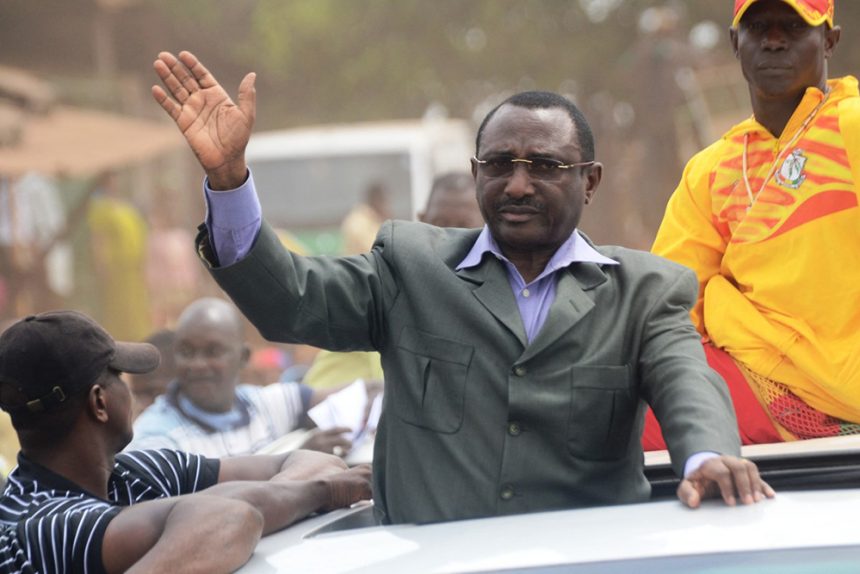
Former Guinean Prime Minister and veteran opposition leader Sidya Touré has died in Paris at the age of 81, following an illness that led to his hospitalisation for about two weeks, according to sources close to his family.
Touré, who led the Union of Republican Forces (UFR), one of Guinea’s major opposition parties, died on Friday in the French capital, where he had been receiving medical treatment after falling ill in Abidjan, Ivory Coast.
Family sources, who spoke to Agence France-Presse (AFP) on condition of anonymity over concerns for their safety, confirmed his death.
A prominent figure in Guinean politics for more than three decades, Touré spent the final years of his life in exile in Ivory Coast after leaving Guinea following the September 2021 military coup that brought Mamady Doumbouya to power.
His death comes amid mounting political tensions in Guinea, where opposition parties and dissenting voices have faced restrictions under the military-led authorities.
In March, the UFR was among 40 political parties dissolved in a government crackdown that drew attention to concerns over civil liberties and political pluralism.
A Long Career in Government and Opposition
Born in 1945 in Ivory Coast, Touré built much of his professional career in economic and financial administration, including service in the Ivorian public sector.
He entered Guinea’s political leadership in July 1996, when then-President Lansana Conté appointed him prime minister. He held the position until March 1999, overseeing administrative and economic reforms and working to strengthen the country’s relationship with international financial institutions.
After leaving government, Touré became leader of the UFR in 2000 and gradually emerged as one of the country’s most prominent opposition figures, challenging successive administrations.
He contested Guinea’s presidential elections in 2010 and 2015 as the UFR candidate but was unsuccessful on both occasions.
Despite disagreements with former President Alpha Condé, Touré also served in his administration, reflecting a political career that included periods of both cooperation and opposition.
Exile Following 2021 Military Coup
Touré left Guinea after the September 2021 military coup, which brought Doumbouya to power, and subsequently settled in Abidjan.
He continued leading the UFR from exile, even as political restrictions in Guinea increasingly limited the activities of opposition groups.
Doumbouya was elected president in December 2025 in a vote that did not include significant opposition parties such as the UFR, the Union of Democratic Forces of Guinea (UFDG) and the Rally of the Guinean People (RPG).
Touré’s absence from Guinea and the exclusion of major opposition parties from the election underscored the challenges facing the country’s political opposition.
Political Leaders Pay Tribute
Tributes have poured in from political figures following the announcement of Touré’s death.
Cellou Dalein Diallo, leader of the UFDG and another prominent opposition figure living in exile, described Touré as a friend and fellow campaigner for Guinea’s political transformation.
In a statement published on Facebook, Diallo said he had lost “a friend and companion in the struggle” for the country.
He recalled their shared ambition to transform Guinea’s considerable resources and potential into a prosperous economy founded on democracy and the rule of law.
Former President Alpha Condé also expressed regret over Touré’s final years in exile, describing it as deeply regrettable that a man who had contributed so much to his country had endured such an ordeal towards the end of his life.
Guinea’s current Prime Minister, Amadou Oury Bah, paid tribute to the late politician in a post on X, remembering him as a “pragmatic reformer” and a prominent figure in the nation’s political life for three decades.
A Legacy in Guinean Politics
Touré’s political career spanned several administrations and significant changes in Guinea’s political landscape. From his time as prime minister under Conté to his leadership of the UFR and years in opposition, he remained an influential voice in national affairs.
His record included efforts to reform public administration and the economy, as well as a sustained campaign for political change.
His death leaves a significant gap in Guinea’s opposition movement, particularly as political parties continue to face restrictions and some of the country’s leading opposition figures remain outside its borders.
Touré is survived by his family. Details of funeral arrangements were not immediately available.