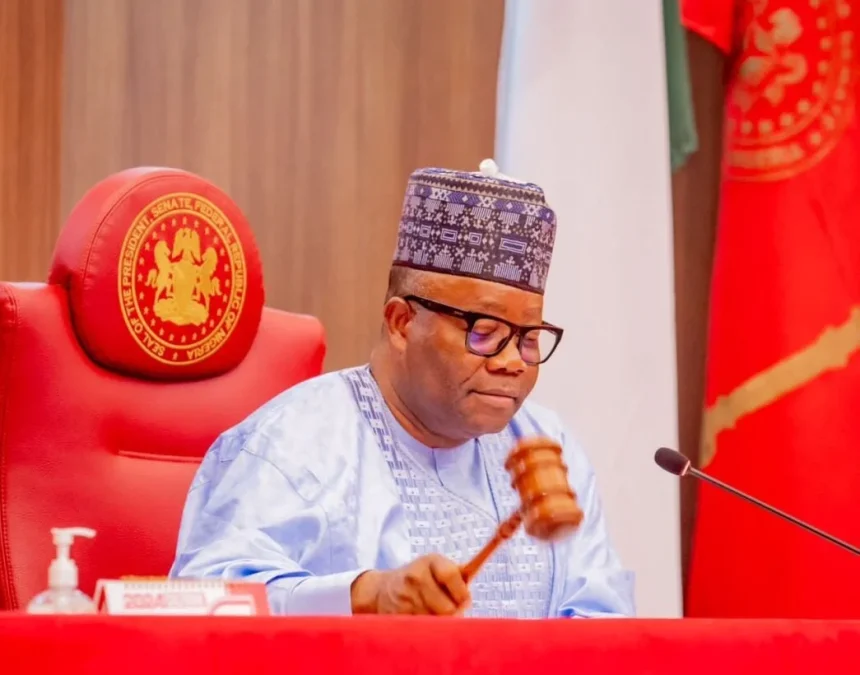
ABUJA, Nigeria — In what is being described as one of the most far-reaching constitutional reforms since Nigeria’s return to democratic rule in 1999, the Senate on Wednesday passed a landmark constitutional amendment bill seeking to establish state police services across the country’s 36 states.
The development marks a significant step toward decentralizing Nigeria’s policing system, replacing the long-standing unitary structure of the Nigeria Police Force with a dual policing framework comprising a Federal Police Service and independent State Police Services.
The executive bill, transmitted to the National Assembly by President Bola Ahmed Tinubu, received overwhelming support from senators after an unusual voting process caused by a technical failure in the Senate’s electronic voting system.

For more than 30 minutes, lawmakers waited as engineers attempted to restore the malfunctioning voting portal. However, with the constitutional amendment hanging in the balance, Senate Leader Opeyemi Bamidele moved a motion for lawmakers to adopt a manual voting process through a show of hands. The motion, seconded by Senate Minority Leader Abba Moro, was unanimously adopted.
More Read

All 88 senators present voted in favour of the bill, paving the way for what many observers consider a historic transformation of Nigeria’s internal security structure.
New policing structure
Under the proposed constitutional amendment, the Federal Police Service will retain exclusive responsibility for matters relating to national security, terrorism, cybercrime, interstate criminal activities, arms trafficking, international organized crime, and the security of the Federal Capital Territory and federal institutions.
Meanwhile, each state will be empowered to establish its own State Police Service to handle community policing, public safety, crime prevention, and other local security responsibilities.
More Read

However, no state police force can begin operations until the state passes the necessary legislation through its House of Assembly and receives certification from the National Assembly confirming that it has met nationally prescribed minimum operational standards.
The legislation also makes it clear that state police officers cannot operate outside their state’s boundaries unless specifically authorized by an Act of the National Assembly.
Safeguards against abuse
Addressing long-standing concerns that governors could misuse state police for political purposes, the bill introduces several constitutional safeguards designed to guarantee operational independence and accountability.
One of the major provisions empowers the President to temporarily assume operational control of a State Police Service under exceptional circumstances, including when a state police command is unable to maintain public order, becomes operationally incapacitated, or is found to be engaging in systematic violations of human rights, political intimidation, or ethnic and religious persecution.
Any such intervention must be made in writing, stating the reasons, geographical scope, and duration of the takeover. The President must also notify the affected governor, the Speaker of the State House of Assembly, the National Police Council, and the National Assembly within 48 hours.
The amendment further provides that any federal intervention must be validated by the Senate, remain subject to judicial review, and cannot continue indefinitely beyond the period prescribed by law.
More Read

Security leaders to enjoy fixed tenure
The constitutional amendment also introduces stronger protections for police leadership.
The Federal Police Service will be headed by an Inspector-General of Police appointed by the President on the advice of the National Police Council and confirmed by the Senate.
Similarly, each State Police Service will be led by a Commissioner of Police appointed by the governor based on the recommendation of the National Police Council and subject to confirmation by the State House of Assembly.
Neither the Inspector-General nor a State Commissioner of Police can be removed arbitrarily. Their removal must follow due process and receive the approval of a two-thirds majority of the appropriate legislative chamber.
Additionally, the bill expressly prohibits political office holders from directing police authorities to arrest, detain, investigate, deploy personnel, or use force against any individual, political party, association, or group for partisan, ethnic, religious, sectional, or personal interests.
Heavyweights witness historic debate
The significance of the legislation attracted several top government officials to the Senate chamber.
Among those in attendance were the Chief of Staff to the President, Femi Gbajabiamila; Kaduna State Governor Uba Sani; Ogun State Governor Dapo Abiodun; Ondo State Governor Lucky Aiyedatiwa; Attorneys-General from several states; and the Director-General of the Nigeria Governors’ Forum, Dr. Abdullateef Shittu.
Leading debate on the bill, Senate Leader Opeyemi Bamidele argued that Nigeria’s highly centralized policing structure had become overstretched in the face of growing security challenges such as banditry, kidnapping, communal conflicts, and violent crimes.
According to him, empowering states with constitutionally recognized police services would improve intelligence gathering, strengthen community policing, and enable quicker responses to local security threats while preserving the Federal Government’s control over national security matters.
Next legislative steps
Although the Senate’s approval represents a major milestone, the constitutional amendment must still secure concurrence from the House of Representatives and be ratified by at least two-thirds of Nigeria’s State Houses of Assembly before it can become part of the Constitution and receive presidential assent.
If eventually enacted, the reform would represent one of the most significant overhauls of Nigeria’s policing and internal security system in over two decades, redefining the relationship between the Federal Government and the states in maintaining law and order.