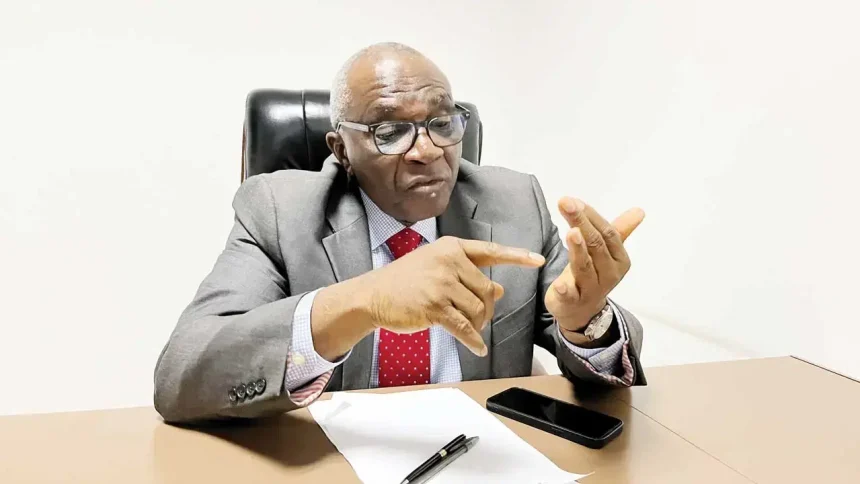
ABUJA, Nigeria — Presidential spokesman Bayo Onanuga has pushed back against claims of widespread hunger and hardship across Nigeria, insisting that many citizens are benefiting from policies and programmes introduced by President Bola Tinubu’s administration.
Speaking during an interview on Arise Television on Tuesday, Onanuga argued that while economic challenges remain, public discourse has become overly focused on negative narratives and often overlooks tangible improvements brought about by government initiatives.
The presidential aide highlighted ongoing infrastructure projects, student loan schemes, and low-interest credit facilities for civil servants as key examples of how the administration is positively impacting the lives of Nigerians.
According to him, recent road construction projects have significantly improved transportation and reduced travel times in several parts of the country.
More Read

Recounting a recent journey from Ibadan to Lagos, Onanuga said he was pleasantly surprised to discover a newly constructed concrete road along the Ijebu-Ode route after Google Maps redirected him due to traffic congestion on the usual Lagos approach.
“One day I was traveling from Ibadan to Lagos, and Google Maps told me that there’s a go-slow in the approach to Lagos, and I decided to take Ijebu-Ode via Shagamu. What struck me most was that I just found myself on a paved road, concrete road. I said, ‘Wow, when was this one built?'” he said.
He noted that the road project had transformed perceptions among residents in the area.
More Read

“I found that our people, I mean, our Ijebu people, have stopped complaining. I said, ‘Oh, no wonder they now have a brand new road that’s not just an asphalt road, a concrete road,'” Onanuga added.
The presidential spokesman also pointed to the Lagos-Calabar Coastal Highway project, which he said has improved mobility and reduced commuting times for residents living in the Lekki-Ajah corridor.
“I live in Ajah. Anytime I go to Lagos, and I ask Google Maps to tell me how soon I will get home, Google Maps will tell me one hour, seven minutes. Before, it was two hours, 30 minutes, and the reason for that is that we now have a coastal road that has shortened my travel time,” he explained.
“Is that not beneficial? What are people talking about really?” he asked.
Beyond infrastructure, Onanuga cited the Federal Government’s student loan programme as a major intervention helping families cope with the rising cost of higher education.
“If you are a parent and you have four children in university, and they’re able to access federal loan, which is interest free, are they not benefiting?” he queried.
More Read

He also referenced affordable credit facilities made available to civil servants, noting that workers can now access loans at single-digit interest rates.
“If you are a civil servant and you can access the credit card, very cheap loan at below interest, it is about seven per cent. Now people can access that loan at single digit. Are they not benefiting as well?” he said.
Onanuga argued that many discussions about the country’s economic condition have been shaped by assumptions and narratives that fail to acknowledge the gains made under the current administration.
“We have been pigeonholed into certain assumptions, certain conclusions,” he stated.
The presidential aide also recalled a viral incident from the early days of President Tinubu’s administration when a video showing the President leaving a mosque in Lagos was accompanied by a voice-over claiming that Nigerians were hungry.
“I think the President went to Lagos, he was coming from the Central Mosque, and somebody now did a voice-over saying ‘Ebi n pawa o,’ and that means we are hungry. Since then, people have been saying that,” he said.

While acknowledging that some Nigerians continue to face economic difficulties, Onanuga maintained that his personal interactions with ordinary citizens and workers around him do not reflect the level of hardship frequently portrayed in public debates.
“I’m a Nigerian. I have people working for me privately. I don’t see the level of hunger people are talking about because I see them, and I keep asking them questions: how are things, how are they adjusting, what are the problems?” he said.
His comments come amid ongoing national conversations about inflation, the rising cost of living, food prices, and the economic reforms introduced by the Tinubu administration since taking office in May 2023.