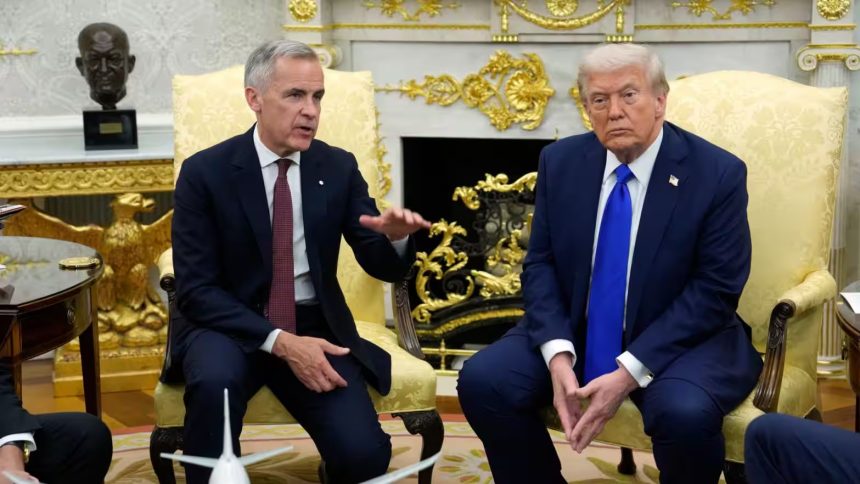
WASHINGTON/OTTAWA — US President Donald Trump has escalated his trade confrontation with Canada after negotiations between the two countries collapsed, with Washington imposing fresh 50% tariffs on about $20 billion worth of Canadian goods.
Trump, reacting publicly to the breakdown in talks, accused Canada of seeking the benefits of being part of the United States without actually becoming a state.
“Canada wants the benefits of being a State, without being one!!!” Trump wrote on social media.
He also accused Canada of imposing heavy tariffs on American farmers for years, declaring that such arrangements would no longer be tolerated.
The latest tariffs, which took effect on Saturday, affect a wide range of Canadian products, including items such as hockey sticks and tongue depressors.
More Read

The move has prompted a strong response from Canadian Prime Minister Mark Carney, who has vowed that Ottawa will respond with tariffs of its own.
Carney said Canada would retaliate “dollar for dollar”, with new tariffs expected to target American products including steel, dairy products, appliances and electronics.
The Canadian measures are expected to take effect from September 8.

Carney: “We Got Attacked”
The latest escalation followed the collapse of trade negotiations in Washington on Friday, with both governments blaming each other for the failure to reach an agreement.
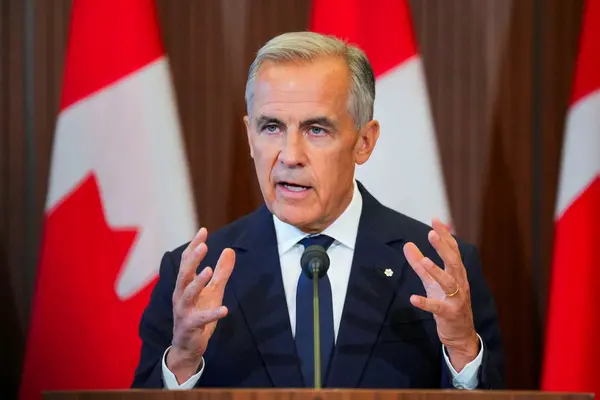
Carney told reporters in Ottawa that Canada was effectively in a trade war with the United States.
“You’re at war when you’re attacked, and we got attacked,” the Canadian prime minister said.
He insisted that Canada could not accept the terms being demanded by the Trump administration.
“We cannot accept what they’ve offered and we will not give what they’ve asked,” Carney said.
More Read

The Canadian leader, a former governor of the Bank of England, came to office after campaigning on a promise to defend Canada’s economic interests amid Trump’s increasingly aggressive trade policies.
US Defends Tariff Decision
The Trump administration, however, has defended the new tariffs, arguing that Washington was responding to what it described as years of retaliatory trade measures from Canada.
US Trade Representative Jamieson Greer said the United States had reached a point where it could no longer accept what he described as unfair trade practices.
“We’ve said enough and so we’ve taken countermeasures,” Greer said.
According to the US trade representative, the measures are intended to protect American workers and strengthen domestic supply chains.
Trade experts have warned that the escalating tariffs could eventually result in job losses and higher costs for businesses and consumers on both sides of the border.
However, analysts believe the political consequences could be even more significant, particularly as relations between the two long-standing allies continue to deteriorate.
USMCA Faces Fresh Uncertainty
The latest confrontation has also raised new questions over the future of the United States-Mexico-Canada Agreement, commonly known as USMCA.
The agreement, which replaced the North American Free Trade Agreement, governs roughly $2 trillion in annual trade in goods and services between the three countries.
Trump signed the agreement during his first term as US president.
However, tensions have intensified after Trump refused this summer to renew the agreement, despite Canada and Mexico formally requesting that it be extended for another 16 years.
Asked about the implications of the latest breakdown in negotiations for the USMCA, Carney admitted that the development was “certainly not good news”.
The future of the trade pact could therefore become another major flashpoint in the increasingly tense relationship between Washington and Ottawa.
A Wider Economic Battle
The US-Canada dispute comes as governments around the world continue to grapple with the effects of Trump’s tariff policies.
Canada and the United States have traditionally enjoyed one of the world’s largest bilateral trading relationships, with businesses on both sides heavily dependent on cross-border commerce.
A prolonged trade war could therefore have consequences beyond the immediate tariff increases.
Companies facing higher import costs could pass those expenses on to consumers, while businesses dependent on cross-border supply chains could be forced to reconsider their operations.
For Canada, the dispute represents a direct challenge to one of its most important economic relationships.
For the United States, the Trump administration maintains that tougher trade measures are necessary to protect American industries, workers and supply chains.
With both sides now preparing further measures, there are growing concerns that the dispute could become a prolonged economic confrontation.
For now, the relationship between the two North American neighbours appears to be entering one of its most difficult periods in decades.