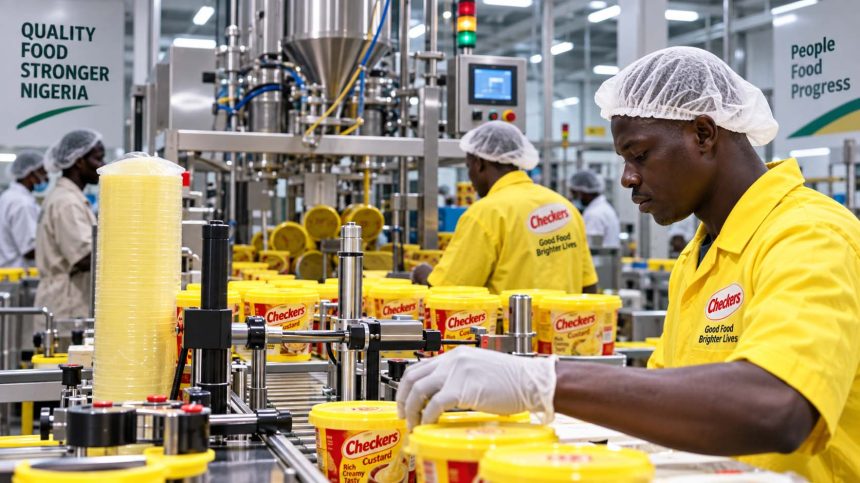
Manufacturing companies listed on the Nigerian Exchange Limited, NGX, entered the second quarter of 2026 with inventories worth approximately N1.77 trillion, as rising production costs and weak consumer purchasing power continued to put pressure on businesses across the country.
Financial Vanguard findings showed that the combined inventories of the manufacturers increased by 10.6 per cent year-on-year, from N1.597 trillion recorded in the corresponding period of 2025.
At the same time, the companies’ combined cost of sales rose by 13.7 per cent, increasing from N1.261 trillion to N1.434 trillion.

The figures point to growing pressure within Nigeria’s manufacturing sector, with companies holding substantially more unsold goods while simultaneously contending with higher costs of producing and distributing their products.

The inventory build-up cuts across several segments of the economy, including consumer goods, building materials, agriculture, food processing and other manufacturing-related businesses.
However, the trend was not uniform across all companies, with some manufacturers recording significant increases in inventory while others posted declines.
Among the companies examined, Dangote Cement recorded the largest inventory position, with N703.58 billion in Q1 2026, compared with N671.55 billion in Q1 2025, representing a 4.8 per cent increase.

UACN recorded one of the sharpest increases, as its inventory surged by 231.8 per cent to N189.55 billion from N57.13 billion.
Okomu Oil Palm followed with a 90.3 per cent increase to N39.90 billion, while Livestock Feeds recorded a 35.9 per cent rise to N9.14 billion.
PZ Cussons’ inventory climbed by 29.7 per cent to N69.37 billion, while Beta Glass recorded a 28.8 per cent increase to N25.21 billion. Vitafoam’s inventory also rose by 12.3 per cent to N23.20 billion.
Other companies recorded more moderate increases. Lafarge’s inventory rose by 7.3 per cent to N110.64 billion, Presco increased by 3.6 per cent to N58.90 billion, while International Breweries recorded a 2.2 per cent increase to N95.83 billion.
Some Manufacturers Record Inventory Decline
Despite the overall increase, some manufacturers succeeded in reducing their stock levels.
Northern Nigeria Flour Mills recorded a 34.6 per cent decline in inventory to N31.46 billion, while NASCON Allied Industries recorded a 17.1 per cent reduction to N14.34 billion.

Cadbury Nigeria’s inventory fell by 16.9 per cent to N27.14 billion, while Unilever Nigeria recorded a 7.7 per cent decline to N23.42 billion.
Nestlé Nigeria’s inventory dropped by 7.3 per cent to N167.84 billion, while Nigerian Breweries recorded a 6.7 per cent decline to N171.92 billion.
Production Costs Remain a Major Concern
The increase in inventories was accompanied by an even faster rise in the cost of sales.
While inventories increased by 10.6 per cent, the combined cost of sales expanded by 13.7 per cent.
Industry analysts warned that if the trend persists, manufacturers could face further pressure on their profit margins unless they are able to pass increased production and distribution costs on to consumers or achieve significant efficiency gains.
Dangote Cement recorded cost of sales of N448.73 billion, representing a 10.2 per cent increase from N407.27 billion.
Nigerian Breweries recorded N233.16 billion, up 7.4 per cent, while Nestlé Nigeria’s cost of sales increased by 10.8 per cent to N194.07 billion.
UACN again recorded the largest percentage increase in the dataset, with its cost of sales rising by 226.8 per cent, from N41.75 billion to N136.41 billion.
PZ Cussons’ cost of sales increased by 51.1 per cent to N25.04 billion, while Champion Breweries recorded a 90 per cent increase to N8.20 billion.
However, some companies recorded improvements. NASCON’s cost of sales declined by 21.1 per cent to N18.89 billion, while Northern Nigeria Flour Mills recorded a 35.9 per cent decline to N5.95 billion.
Okomu Oil Palm reduced its cost of sales by 24.5 per cent to N11.70 billion, while International Breweries recorded a 9.1 per cent decline to N103.61 billion.
Analysts Blame Weak Demand, High Production Costs
President of the Chartered Institute of Stockbrokers, Fiona Ahimie, attributed the increase in inventories to a combination of supply- and demand-side factors.
According to her, many manufacturers had invested significantly in expanding production capacity as operating conditions improved and access to foreign exchange became more stable.
The increased production, she noted, had not been matched by a corresponding rise in consumer demand.
Although inflation has moderated, Ahimie said prices remain high relative to household incomes, forcing many Nigerians to prioritise essential goods while cutting back on discretionary spending.
She also noted that some manufacturers were deliberately building inventories in anticipation of stronger demand in coming quarters.
On production costs, Ahimie identified energy, transportation, logistics, raw materials and interest rates as major challenges confronting manufacturers.
She called for improved infrastructure, particularly reliable electricity and transportation networks, as well as greater access to affordable financing.
According to her, reliable power supply would significantly reduce the costs incurred by manufacturers that currently depend heavily on generators.
Inflation and Insecurity Add to Manufacturers’ Burden
Managing Director of Highcap Securities Limited, David Adonri, also linked the inventory build-up to inflation and declining consumer purchasing power.
Adonri said the erosion of household purchasing power had adversely affected consumer demand, while rising energy and distribution costs had added to manufacturers’ burden.
He also identified insecurity as a major factor affecting domestic production, particularly through its impact on agricultural and other sources of raw materials.
He argued that efforts to stimulate demand would have limited impact unless inflation and supply constraints were addressed.
According to him, restoring security across the country would allow rural economic activities to recover and help close existing supply gaps.
High Interest Rates Continue to Weigh on Businesses
Managing Director of Arthur Steven Asset Management Limited, Olatunde Amolegbe, said the inventory increase reflected both demand- and supply-side dynamics.
He noted that although inflation had moderated significantly from its 2024 peak of 33.4 per cent to 15.91 per cent as of June 2026, the effects of the previous period of high inflation continued to weigh heavily on household purchasing power.
Amolegbe said consumer demand was gradually recovering but remained insufficient to absorb production, particularly for discretionary and non-essential goods.
He also pointed to the restrictive monetary policy environment, noting that the Monetary Policy Rate had been maintained at 26.5 per cent at the Monetary Policy Committee meeting of July 22, 2026.
According to him, high financing costs continue to constrain consumption, inventory financing and business expansion.
He explained that some manufacturers had continued production in order to preserve market share, fulfil distribution commitments and maintain efficient capacity utilization, even when sales growth failed to keep pace with production.
This, he said, had contributed to inventory accumulation.
Some manufacturers, he added, may also be deliberately maintaining higher stock levels as a buffer against possible supply-chain disruptions or future increases in input costs.
Call for Government Intervention
Amolegbe urged the government to continue investing in reliable electricity, transportation infrastructure and logistics networks while expanding access to affordable financing for productive sectors.
He also advocated greater support for local sourcing of raw materials through backward integration initiatives and targeted fiscal incentives for manufacturers.
On the demand side, he said policies that promote employment, improve productivity and increase real household incomes would help strengthen consumer purchasing power.
Industry analysts broadly agree that the challenge facing manufacturers is not simply the volume of goods being produced, but the ability of consumers to afford those goods.
With inventories rising faster than consumer demand and production costs continuing to climb, manufacturers may face increasing pressure to either reduce production, offer more competitive prices or absorb higher costs.
The direction of household purchasing power, inflation, interest rates, energy costs and supply-chain conditions will therefore remain critical to determining whether the current inventory build-up becomes a temporary adjustment or a more persistent challenge for Nigeria’s manufacturing sector.