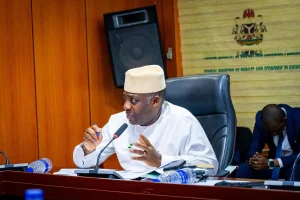
KYIV — Ukraine is losing an estimated $45 million for every hour that missile alerts bring businesses and economic activity to a standstill, as the country struggles to keep its economy functioning amid an intensifying Russian bombardment.
Ukraine’s Economy and Environment Minister, Oleksandr Kravchenko, said Russia’s expanding campaign of attacks was increasingly targeting the infrastructure that supports the country’s economy, including industrial facilities, warehouses, logistics hubs and data centres.
“What we had not fully anticipated was how quickly Russia would develop these jet-powered drones and use them to target everything,” Kravchenko said.
Speaking from the heavily protected government complex in Kyiv, the minister said repeated air-raid alerts were forcing businesses to suspend operations as employees sought shelter.
According to Kravchenko, sirens can remain active for as long as 10 hours a day in some areas.
More Read

“If people are in a bunker, business stops,” he said.
Two-Tier Alert System Introduced
In an effort to reduce the economic impact of prolonged warnings, the Ukrainian government has introduced a two-tier alert system.
More Read

Under the new system, a red alert signals a missile threat and requires people to seek shelter, while a yellow alert, issued for drone threats, allows many businesses to continue operating.
Kravchenko said more than half of businesses were continuing to operate during yellow alerts.
However, the system carries significant risks.
On Monday, a Russian jet-powered drone struck the National Academy of Sciences in central Kyiv during a yellow alert, killing two people while staff were still inside the building.
The incident highlighted the difficult balance Ukraine faces between protecting civilians and maintaining economic activity during the war.
$10 Billion in Damage
Kravchenko estimated that Russian attacks had caused approximately $10 billion in damage to fixed assets this year alone.
More Read

Steel plants, warehouses and logistics infrastructure have been among the targets, while attacks on data centres and other digital infrastructure have added a new dimension to the economic pressure.
Ukraine’s Black Sea ports have also faced severe disruption, with the country’s export routes heavily affected by Russia’s naval blockade.
The minister warned that Ukraine could be facing its “hardest, the harshest winter” of the war, with continued pressure expected on energy supplies, infrastructure and businesses.
Government Seeks More Air Defence
To reduce the risk of future attacks, Kyiv is considering allowing more private companies to purchase air-defence systems, according to Kravchenko.
But he acknowledged that businesses would not be able to completely protect themselves against Russian missiles and drones.
The government is also seeking to develop drones capable of intercepting Russia’s increasingly sophisticated jet-powered weapons.
Ukraine’s Budget Under Pressure
The continuing destruction has intensified pressure on Ukraine’s already stretched finances.
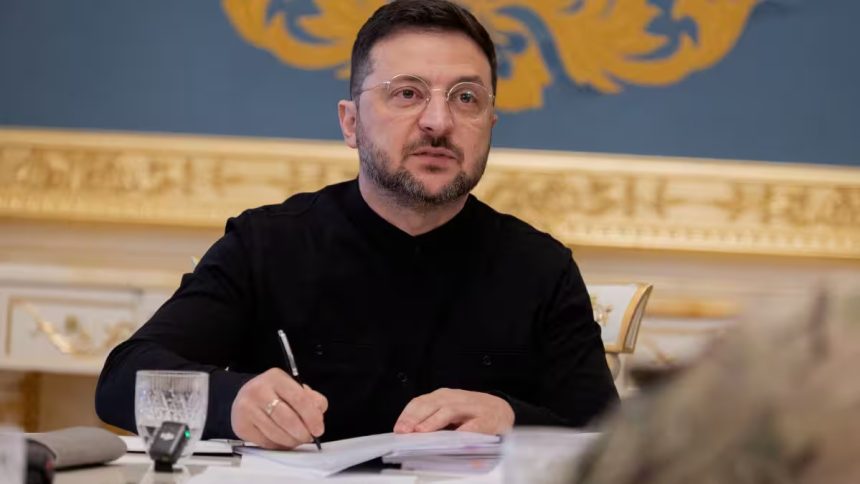
President Volodymyr Zelenskyy recently put the country’s remaining budget shortfall for the year at around $27 billion.
Kravchenko said the government had since reduced the gap to approximately $20 billion through spending cuts and the identification of additional domestic resources.
Ukraine is now seeking additional assistance from international partners including the European Union, Japan, Canada and the United Kingdom.
The government is also considering bringing forward loans originally intended for next year.
“There is very active work with all our international partners to get additional sources of funding,” Kravchenko said.
Corruption Concerns Persist
The minister rejected suggestions that the budget gap was caused by government mismanagement or corruption, saying instead that weaker-than-expected revenues and the rising cost of the war were primarily responsible.
However, corruption remains a major concern for Ukrainians and international donors.
A recent survey by the Kyiv International Institute of Sociology found that 50% of respondents identified government corruption as their biggest concern, compared with 40% who cited mass missile and drone attacks.
The survey also found that 72% of respondents believed Zelenskyy bore personal responsibility for corrupt actions involving people around him.
Kravchenko acknowledged that Ukraine still faces both the reality of corruption and what he described as a persistent perception problem at home and abroad.
He said pressure from European partners had helped push reforms forward, while stressing the need to improve public confidence.

$52.6 Billion Needed for 2027
Ukraine’s external financing requirements for 2027 are estimated at approximately $52.6 billion, but only around $20 billion has so far been secured, according to Kravchenko.
Further tax increases and spending reductions are being considered as the government attempts to close the gap.
The minister also expressed concern about growing war fatigue across Europe and the emergence of political forces in countries such as France and Germany that are sceptical of continued support for Ukraine.
“Am I worried? I think I should be, probably,” he said.
“The overall fatigue is increasing in Europe.”
For Kyiv, the challenge is becoming increasingly complex: maintaining economic activity, protecting civilians, financing the war and sustaining international support while Russian attacks continue to damage the infrastructure on which Ukraine’s economy depends.