Canadian Prime Minister warns of economic risks, urges strong voter turnout as Alberta prepares to decide its future within Canada
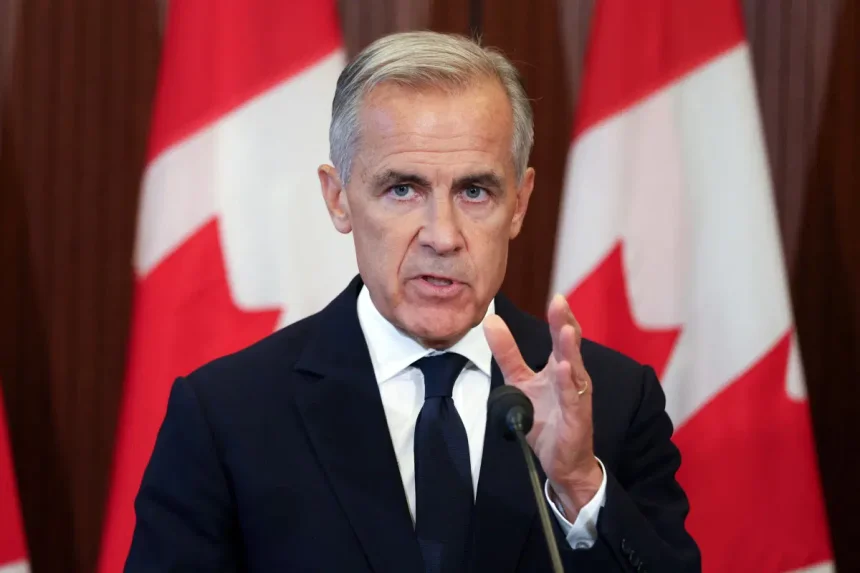
Canadian Prime Minister Mark Carney has called on Albertans to reject independence and remain part of Canada, warning that the stakes are high as the oil-rich province prepares for a crucial referendum on Monday, October 19.
Speaking at a pro-unity rally in Calgary on Thursday, Carney urged voters to deliver a decisive rejection of separation, describing the timing of the referendum as particularly challenging amid growing global instability and economic uncertainty.
“The stakes are high,” Carney told supporters, arguing that Alberta’s future would be better secured within a united Canada.
More than 7,000 people attended the rally, one of two pro-unity events scheduled for the prime minister in Alberta ahead of the vote. Carney is expected to attend another gathering in Edmonton, his hometown, as the campaign enters its final stages.
More Read

The referendum has attracted significant public attention, with more than 450,000 Albertans reportedly having already voted through early or mail-in ballots.
The ballot question asks voters whether Alberta should remain part of Canada or begin the process of holding a binding referendum on separation.
Although polling suggests that most Albertans favour remaining in Canada, Carney cautioned against assuming the outcome was already determined.
More Read
“Turnout will determine the outcome,” he said, encouraging supporters of Canadian unity to participate in the vote.

Carney Warns Against Economic and Security Risks
In his address, Carney pointed to mounting international tensions and economic pressures as reasons for Alberta to remain within the Canadian federation.
“The world has become more dangerous and divided. Some outside our borders are working to break us so they can own us,” he said.
His remarks echoed previous warnings about the impact of tariffs imposed by United States President Donald Trump on Canada’s economy and broader national security.
Carney’s argument is that national unity would strengthen Canada’s ability to withstand external economic pressure, protect jobs and maintain its position in an increasingly competitive global environment.
More Read

Supporters of Alberta independence, however, argue that the province has not received sufficient recognition or economic benefits from the federal government despite its substantial contribution to Canada’s oil and gas industry.
They accuse successive Liberal administrations of prioritising environmental policies over the development of Alberta’s energy resources and maintain that independence would allow the province to retain more of its wealth.
Alberta’s Oil Wealth at the Centre of the Debate
Alberta’s substantial oil and gas reserves have become a central issue in the independence debate.
Separatist campaigners argue that the province’s economic interests have frequently been overlooked by federal politicians in Ottawa. They believe greater political autonomy, or outright independence, would enable Alberta to exercise more control over its natural resources, revenues and economic policies.
Opponents of separation have countered that independence could expose the province to significant financial and economic risks.
They warn that a newly independent Alberta could face billions of dollars in debt obligations, uncertainty over trade and constitutional arrangements, and the possible departure of businesses, investors and skilled workers.
The competing arguments have drawn comparisons with Britain’s 2016 Brexit referendum, in which voters chose to leave the European Union.
Carney and other opponents of Alberta separation have invoked Brexit as a warning about the potentially far-reaching and unintended consequences of withdrawing from an established political and economic union.
Carney Promises Support for Alberta’s Energy Industry
Despite his opposition to separation, Carney acknowledged that dissatisfaction among some Albertans was genuine.
“The frustrations that many Albertans have felt are real,” he said, signalling his government’s willingness to address concerns about the province’s economic future.
In the weeks preceding the referendum, the prime minister announced plans to fast-track approval of a proposed oil pipeline linking Alberta to Canada’s Pacific coast.
Carney has described the project as “a demonstration of the power of Canada”, arguing that it could help the country diversify its energy export markets and reduce its dependence on the United States amid continuing tariff disputes.
The proposed pipeline has become an important part of the federal government’s broader argument that Alberta’s energy industry can expand within Canada while contributing to the country’s economic resilience.
For Carney, supporting Alberta’s energy sector while maintaining national unity is central to persuading voters that the province’s concerns can be addressed without breaking away from the federation.
Immigration Questions Create Further Political Tensions
Beyond the separation question, Albertans will also vote on nine additional ballot questions, several of which focus on whether the province should exercise greater control over its immigration system.
Carney has urged voters to reject the nine additional proposals, using the slogan “vote no to the nine”.
His position puts him at odds with Alberta Premier Danielle Smith, who introduced the questions and has encouraged voters to support them.
Smith, a Conservative whose political base includes supporters of independence, has advocated for Alberta to remain within Canada while maintaining that the referendum provides an opportunity for residents to express their views directly.
Responding to Carney’s remarks on X on Thursday, Smith said she and the prime minister “have found common ground on many things”.
However, she criticised his understanding of how federal immigration policies have affected the cost of living in Alberta.
The disagreement highlights the broader political tensions surrounding immigration, housing affordability, economic management and provincial autonomy.
Political Leaders Make Final Appeals to Voters
With the referendum approaching, political leaders and campaign groups are intensifying efforts to mobilise supporters.
Smith is scheduled to appear at a separate pro-unity event in Calgary on Friday alongside Conservative opposition leader Pierre Poilievre, who has also called for Alberta to remain part of Canada.
Meanwhile, advocates of Alberta separation are preparing for a rally in Edmonton on Saturday as they seek to build momentum and increase voter participation ahead of Monday’s ballot.
The early voting figures suggest considerable public engagement, with the average number of ballots cast reportedly already exceeding participation levels recorded during Alberta’s previous provincial general election.
The high turnout could prove decisive in a contest where campaigners on both sides are urging residents not to take the outcome for granted.

Alberta Faces a Defining Political Moment
The October 19 referendum represents a significant moment in Alberta’s ongoing debate over its relationship with the federal government and the future of its energy-driven economy.
For supporters of Canadian unity, remaining in the federation offers greater economic stability, shared national resources and a stronger position in dealing with international challenges.
For independence advocates, separation represents an opportunity to gain greater control over the province’s wealth, policies and political future.
As campaigning enters its final days, Carney’s message is clear: Alberta’s grievances must be addressed, but he believes separation is not the answer.
The outcome will depend on whether voters accept that argument and turn out in sufficient numbers to determine the province’s next political chapter.
As Albertans prepare to cast their ballots, the central question remains whether the province’s future prosperity is best secured within Canada or through a renewed pursuit of independence.