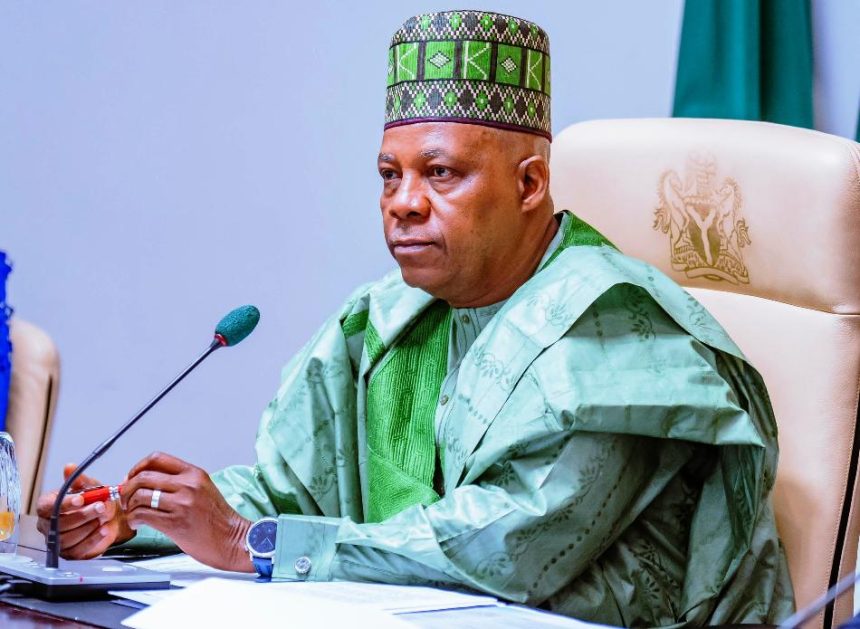
ABUJA — Vice-President Kashim Shettima has called on state governments across Nigeria to stop relying solely on the Federal Government to address electricity challenges, urging them to establish functional electricity markets, strengthen regulatory institutions and attract private investment to improve power supply.
Shettima said Nigeria’s ambition to build a competitive industrial economy would remain constrained unless ongoing electricity reforms translated into reliable and affordable power for businesses, households and public institutions.
The Vice-President made the call on Wednesday while declaring open the National Stakeholders’ Workshop on the Electricity Act 2023 at the Banquet Hall of the State House, Abuja. He was represented at the event by the Deputy Chief of Staff to the President, Senator Ibrahim Hassan Hadejia.
According to him, the Electricity Act 2023 provides state governments with an opportunity to develop and regulate electricity markets within their respective jurisdictions, enabling them to adopt solutions that reflect local needs, available resources and economic priorities.
“Electricity supply must become a shared responsibility, pursued with innovation and accountability across the federation. Our States must shed the habit of waiting for Abuja to provide every answer,” Shettima said.
More Read

States Urged to Harness Local Energy Resources
Shettima identified the significant energy resources available across different parts of the country as opportunities for states to expand electricity generation, attract investors and stimulate economic development.
He pointed to solar energy potential in Sokoto, Borno and Katsina states, natural gas resources in Delta, Rivers and Bayelsa states, and hydroelectric opportunities in Niger and Kebbi states.
More Read

He urged state governments to develop these resources through strategic investments capable of improving electricity access and supporting critical sectors, including agriculture, manufacturing, healthcare and education.
The Vice-President stressed that states must move beyond policy declarations and take practical steps to establish the institutions and market structures required to make electricity reforms effective.
He warned that passing legislation alone would not automatically improve electricity supply, noting that states yet to establish the necessary regulatory institutions should begin their legislative and institutional preparations without delay.
“Legislation cannot implement itself. States yet to act must begin their legislative and institutional preparations promptly,” he said.
Shettima Proposes National Peer Review Framework
To accelerate implementation of the electricity reforms, Shettima proposed the establishment of a National Electricity Reform Peer Review and Implementation Framework involving the Nigerian Electricity Regulatory Commission (NERC), the Federal Ministry of Power, the Nigeria Governors’ Forum and state electricity regulators.
He said the proposed voluntary framework would provide a platform for states to exchange experiences, strengthen regulatory capacity and assess progress in investment, consumer protection, electricity access and market development.
More Read

The initiative, he explained, would enable states to learn from the experiences of jurisdictions that had already made progress in developing their electricity markets, helping others avoid similar mistakes and accelerate implementation.
“No state needs to purchase with failure the knowledge another state has already acquired,” Shettima said.
He added that effective collaboration between federal and state institutions would be essential to achieving a more coordinated and sustainable electricity sector.
Private Investment Critical to Electricity Transformation
The Vice-President also emphasised the importance of private capital in addressing Nigeria’s electricity infrastructure deficit, noting that government funding alone would not be sufficient to finance the scale of investment required.
“Government cannot finance this transformation from the treasury alone; private capital must arrive with technology and expertise,” he said.
Shettima explained that attracting investors would require transparent licensing procedures, predictable regulatory policies, commercially viable electricity markets and effective mechanisms for resolving disputes.
He maintained that a stable and transparent operating environment would help build investor confidence, encourage long-term commitments and support the development of electricity infrastructure across the country.
For state governments, the reforms present an opportunity to develop electricity markets that reflect local economic conditions while encouraging private participation in generation, distribution and other areas of the power value chain.
However, the realisation of these opportunities will depend on effective regulation, sound commercial arrangements, infrastructure development and the ability of electricity operators to deliver dependable services to consumers.
Consumer Protection Must Remain a Priority
While advocating greater private-sector participation, Shettima stressed that electricity market reforms must also protect consumers from arbitrary billing, poor service delivery and unfair commercial practices.
He said electricity operators must be held accountable for the quality of service they provide, adding that the success of the Electricity Act would ultimately be measured by its impact on the everyday lives of Nigerians.
“The final verdict on this law will be delivered wherever a Nigerian reaches for a switch. Entrepreneurs need dependable power, young Nigerians need employment, and investors need transparent rules under which enterprise can prosper,” he said.
His remarks highlighted the need to balance commercial sustainability with consumer interests as states develop their electricity markets and introduce regulatory frameworks suited to their jurisdictions.
Governors’ Forum Working on Standard Tariff Framework
Also speaking at the workshop, the Director-General of the Nigeria Governors’ Forum, Dr Abdulateef Shittu, said the forum was working to improve coordination between federal and state institutions to support the implementation of the Electricity Act 2023.
Shittu disclosed that efforts were underway to develop a standard tariff framework for states, with the objective of protecting consumers while ensuring that electricity markets remained commercially sustainable and attractive to investors.
A well-designed tariff framework is expected to address the need to balance the cost of supplying electricity with consumers’ ability to pay, while providing a clearer basis for investment and market development.
Earlier, the Permanent Secretary in the Federal Ministry of Power, Mahmuda Mamman, said the success of the legislation would depend largely on states establishing credible regulatory institutions and developing commercially viable electricity markets.
He stressed the importance of translating the provisions of the law into practical actions capable of improving electricity access and supporting economic growth.
NERC Transfers Regulatory Oversight to 17 States
Meanwhile, the Deputy General Manager and Head of Compliance at the Nigerian Electricity Regulatory Commission, Hauwa Yakubu, disclosed that the commission had transferred regulatory oversight to 17 states, with Akwa Ibom the latest state to receive the transfer.
The development represents an important step in the transition towards greater state-level participation in electricity regulation under the framework established by the Electricity Act 2023.
Yakubu said NERC was providing technical support to emerging state regulators through regulatory engagement and peer-to-peer training to strengthen their capacity to address electricity challenges within their respective jurisdictions.
The support is intended to help state regulators build the expertise and institutional capabilities needed to oversee their electricity markets effectively.
Electricity Reform and Nigeria’s Economic Growth
The discussions at the workshop underscored the importance of effective implementation of the Electricity Act 2023 in expanding electricity access, improving service delivery and creating opportunities for investment across Nigeria.
For businesses, more reliable electricity could help reduce dependence on alternative power sources, lower operating pressures and improve productivity. Households and public institutions could also benefit from improved access to dependable electricity, provided that market reforms translate into better service and appropriate consumer safeguards.
For state governments, the immediate challenge is to establish credible regulatory institutions, create transparent market rules, mobilize investment and ensure that electricity operators are accountable for their performance.
As more states develop their electricity markets, coordination between federal and state authorities will remain important in addressing regulatory challenges and supporting the broader development of the sector.
Ultimately, the success of the reforms will depend not only on the establishment of new institutions and markets but also on whether Nigerians experience measurable improvements in electricity availability, affordability and reliability.