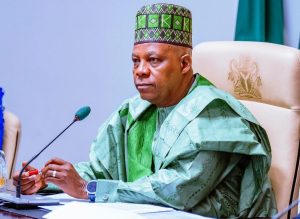
CBN Governor Cardoso Says Rate Reset Reflects New Economic Realities
The Central Bank of Nigeria (CBN) has reduced the Monetary Policy Rate (MPR) by 350 basis points, cutting the benchmark interest rate from 26.5 per cent to 23 per cent in a major adjustment that has triggered mixed reactions across Nigeria’s business and financial sectors.
The decision was announced by CBN Governor, Olayemi Cardoso, at the conclusion of the 307th meeting of the Monetary Policy Committee (MPC) in Abuja.
Cardoso described the move as a reset of the monetary policy framework to better reflect prevailing financial-market realities.

According to the governor, the adjustment was made against the backdrop of moderating inflation, exchange-rate stability, improved foreign-exchange market liquidity and stronger external reserves.
More Read

However, while some economists and capital-market stakeholders welcomed the decision as a major relief for businesses and investors, others argued that the new 23 per cent rate remains too high to significantly reduce the cost of borrowing or stimulate economic activity.
CBN: Rate Adjustment Is Not a Policy Shift
Explaining the decision, Cardoso said the MPC also recalibrated the standing facilities corridor to +50/-300 basis points around the MPR.
The committee retained the Cash Reserve Requirement (CRR) at 45 per cent for Deposit Money Banks, 16 per cent for Merchant Banks and 75 per cent for non-TSA public-sector deposits.
More Read

The CBN governor stressed that the adjustment should not be interpreted as a change in the overall monetary policy stance.
Rather, he said it represented an operational realignment designed to strengthen monetary policy transmission and restore the MPR as the principal signal of monetary policy.
Cardoso explained that the MPC had observed a divergence between the MPR and prevailing market rates, which had weakened the effectiveness of monetary policy transmission.
He said the decision to reset the policy rate was therefore intended to better align the monetary policy implementation framework with prevailing market realities.

Cardoso: ‘No Better Time to Do It’
The CBN governor said the current economic environment provided a suitable opportunity for the adjustment, pointing to improvements in the foreign-exchange market and investor confidence.
More Read

According to him, previous monetary tightening measures had helped reduce pressure in the FX market while supporting improvements in inflation and external-sector conditions.
He said:
“We are in a position of stability. The tightening we have done in the past has worked. FX pressure has receded. Capital market growth is because of the FX market stability. Investor confidence has come back.”
Cardoso added that the country had nothing to fear from the adjustment because the move represented a reset and recalibration of the monetary framework.
Nigeria’s External Reserves Hit $55.25bn
The CBN governor also disclosed that Nigeria’s gross external reserves had risen to $55.25 billion as of September 18, 2026, describing the figure as the highest level recorded in 18 years.
He said the reserves were sufficient to finance approximately 11.3 months of imports of goods and services.
Cardoso, who marked three years in office, attributed some of the CBN’s achievements during his tenure to reforms aimed at stabilizing the foreign-exchange market.
He said the reforms had helped address what he described as unsustainable subsidy arrangements and strengthened the resilience of the Nigerian economy.

CPPE: Rate Cut Is a Major Relief for Real Sector
The Chief Executive Officer of the Centre for the Promotion of Private Enterprise (CPPE), Dr Muda Yusuf, welcomed the decision, describing it as a timely reset and a major relief for the real sector.
Yusuf said the adjustment came at a time when inflation was moderating while businesses continued to face the burden of an excessively restrictive monetary environment.
He pointed to what he described as a widening gap between the previous 26.5 per cent MPR, inflation of about 15.4 per cent and prevailing money-market rates of around 20 per cent.
According to him, the divergence weakened the signalling function of the policy rate.
He said the reduction to 23 per cent should therefore be viewed as an important realignment with prevailing macroeconomic and financial-market conditions.
Yusuf said the real sector stood to benefit if the lower policy rate translated into cheaper financing.
He identified manufacturing, agriculture, construction, logistics and other capital-intensive sectors as areas where high borrowing costs had constrained investment, production and working capital.
He added that the adjustment could help reduce the cost of capital, improve business cash flows and stimulate investment.
However, Yusuf cautioned that the ultimate economic impact would depend on how effectively the rate cut is transmitted to businesses and consumers.
Customs Agents: 23% Still Too High for Businesses
Not all stakeholders were convinced that the rate cut would provide sufficient relief.
The National President of the National Council of Managing Directors of Licensed Customs Agents (NCMDLCA), Lucky Amiwero, said the new rate remained too high for businesses that rely heavily on bank credit.
Amiwero argued that businesses continue to face significant challenges accessing affordable financing despite the reduction.
He said:
“It is still high. When you look at the economy, they have removed subsidies and they have removed the floating currency. What is the bargaining power of anybody today?”
He maintained that a 23 per cent policy rate would continue to make access to credit difficult for many operators.
Amiwero also highlighted infrastructure challenges, including inadequate electricity and poor roads, which he said further increase the cost of doing business.
He called for additional measures by the government and the CBN to make affordable credit available and improve the operating environment for businesses.
Capital Market Eyes New Investment Opportunities
The President of the Chartered Institute of Stockbrokers (CIS), Fiona Ahimie, described the MPR reset as a significant development for the capital market.
She said the immediate impact could be felt in the fixed-income market as investors begin to price in a lower interest-rate environment.
According to her, yields on government securities could moderate, particularly at the shorter end of the yield curve.
Ahimie said lower returns on Treasury bills and other short-term instruments could lead some investors to consider longer-dated bonds and equities.
She also noted that lower interest rates could improve the valuation of future corporate cash flows while potentially reducing financing costs for businesses.
However, she cautioned that the impact would not necessarily be uniform across all sectors.
The banking sector, for instance, could experience both increased loan demand and pressure on net interest margins depending on how quickly lending and deposit rates reprice.
Professor Uwaleke Welcomes CBN Decision
President of the Capital Market Academics of Nigeria, Professor Uche Uwaleke, also welcomed the MPC decision.
Uwaleke said the 350-basis-point reduction was justified by moderating inflation, exchange-rate stability, improved foreign-exchange market liquidity and growth in external reserves.
He described the development as welcome, particularly in the context of the recently signed memorandum of understanding between the Minister of Finance and the CBN governor on fiscal and monetary policy collaboration.
VNL Capital: ‘Aggressive Attack on Economic Misery’
The Chief Investment Officer of VNL Capital Asset Management, Dr Ubah Jeremiah, described the size of the reduction as a surprise.
Jeremiah said market expectations had largely centred on a more cautious cut of between 50 and 100 basis points, making the 350-basis-point reduction to 23 per cent a significant signal from the CBN.
He linked the decision to developments in inflation, naira stability and reserve accumulation, describing it as an aggressive response to Nigeria’s economic difficulties.

What the Rate Cut Means for Nigerians
The reduction in the MPR could have implications across the economy, although the eventual impact will depend largely on how commercial banks and other financial institutions respond.
For businesses, a reduction in borrowing costs could potentially improve access to credit, lower financing expenses and support investment.
For investors, lower interest rates could alter the relative attractiveness of fixed-income securities and encourage some movement toward equities and longer-term investments.
For consumers, the key question will be whether the adjustment eventually translates into lower lending rates for personal and business loans.
At the same time, policymakers will need to balance the desire for cheaper credit with the need to sustain the recent progress on inflation and exchange-rate stability.
The CBN has maintained that the latest decision is primarily an operational reset designed to strengthen monetary policy transmission, rather than a fundamental shift away from its broader monetary policy objectives.
With the MPR now at 23 per cent, attention will turn to how quickly the decision translates into actual lending rates, investment activity, business expansion and broader economic conditions.