ABUJA — The lingering political disagreement between Minister of the Federal Capital Territory (FCT), Nyesom Wike, and a section of governors elected on the platform of the All Progressives Congress (APC) has reportedly divided the party’s 31 state governors into different camps ahead of the 2027 general elections.
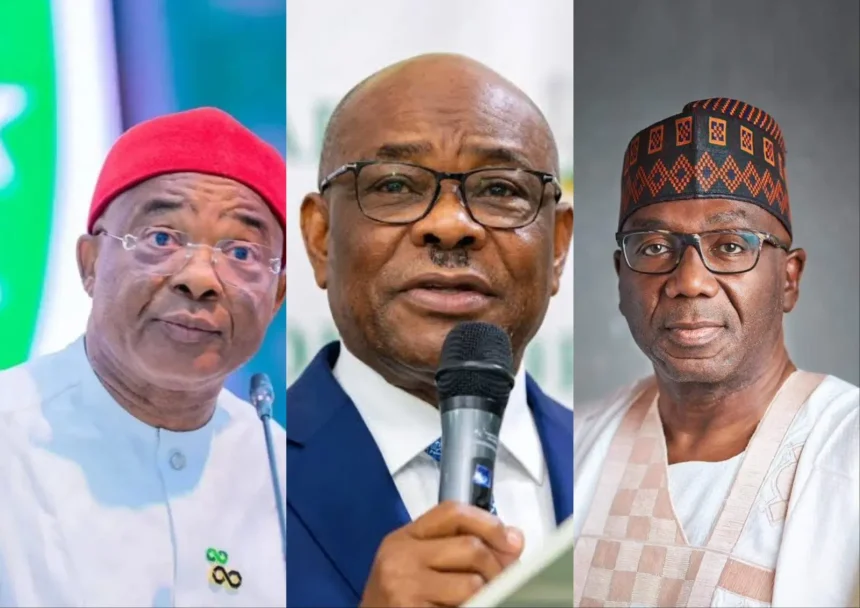
While some governors are said to be sympathetic to Wike, others are reportedly backing the Chairman of the Progressive Governors’ Forum (PGF) and Imo State Governor, Hope Uzodimma, as well as Kwara State Governor and Chairman of the Nigerian Governors’ Forum (NGF), AbdulRahman AbdulRazaq.
A senior party source reportedly said not all APC governors were opposed to Wike, noting that the FCT minister had maintained relationships with several governors from his years in politics.
Among those reportedly sympathetic to Wike are Adamawa State Governor Ahmadu Fintiri, Akwa Ibom Governor Umo Eno, Edo Governor Monday Okpebholo, Lagos Governor Babajide Sanwo-Olu, and Kogi Governor Ahmed Ododo.
On the other side, Uzodimma, AbdulRazaq, Kaduna Governor Uba Sani and Ogun Governor Dapo Abiodun, among others, are reportedly opposed to Wike’s political position in the unfolding dispute.
More Read
Some governors are said to have refrained from taking sides, preferring to await the return of President Bola Tinubu before making a definitive decision.
The disagreement became increasingly public following reported moves by the PGF to ensure that APC governors support only candidates officially nominated by the party in the 2027 elections.
The position has been interpreted by political observers as a response to Wike’s reported Rainbow Coalition project, which involves political actors working across party lines.
More Read
The governors reportedly expressed concern that candidates backed by the coalition could contest National Assembly and other elections on opposition platforms, potentially creating conflicting political interests for voters and affecting the APC’s electoral strategy.
Wike, however, has rejected the suggestion that opposition to his political activities is primarily motivated by concerns over the stability of the APC.
The FCT minister has instead alleged that Uzodimma and AbdulRazaq have other political interests behind their opposition, including speculation surrounding the Imo governor’s reported interest in the Senate presidency.
Wike has also publicly criticized AbdulRazaq over political developments in Kwara State, particularly allegations concerning his involvement in the emergence of political candidates in the state.
Wike Reveals Strategy Against Atiku, Obi
Meanwhile, Wike has disclosed that a political strategy has been developed ahead of the 2027 presidential election to counter former Vice President Atiku Abubakar of the African Democratic Congress (ADC) and Peter Obi of the Nigeria Democratic Congress (NDC), according to the account provided.
Speaking after an inspection of several infrastructure projects in Abuja, Wike revisited the political strategy adopted by the Peoples Democratic Party’s (PDP) G5 governors during the 2023 presidential election.
More Read

Wike said the G5’s objective at the time was to prevent Atiku from securing substantial votes in the South-South, a region traditionally associated with the PDP.
According to him, the strategy was to encourage voters to support Obi, thereby reducing Atiku’s vote share.
“Our strategy was, make sure that you vote for Obi to win in order to deny Atiku the votes,” Wike said.
He maintained that Atiku, rather than Obi, was regarded as the principal political threat to the G5 bloc at the time.
The minister also rejected allegations that the 2023 election result in Rivers State was manipulated, arguing that no evidence was presented before the tribunal to establish that the Labour Party had actually won the state.
Wike said political actors inevitably develop strategies based on their assessment of electoral threats.
He also suggested that Obi’s perceived political strength had been amplified by social media, arguing that electoral calculations should be based on actual voting patterns rather than online popularity.
Wike Reaffirms Support for Tinubu
Wike also reaffirmed his support for President Tinubu’s bid for another term in office.
He said having supported Tinubu during the 2023 presidential election, he would not support another candidate against the president in 2027.
“After supporting President Tinubu in 2023, it will be wrong of me to support another person to face him when he is seeking re-election,” Wike said.
However, he maintained that his personal position on the presidential election should not prevent the PDP from participating in governorship, state assembly, National Assembly and other sub-national elections.
Wike made the comments when members of the PDP Board of Trustees (BoT), led by its chairman, Senator Mao Ohuabunwa, visited him at his Abuja residence to condole with him over the death of the party’s National Vice Chairman, South-South, Chief Dan Orbih.
Ohuabunwa said the delegation had also visited to encourage Wike to remain focused, while describing his criticisms of the PDP as truthful.
The latest developments highlight the increasingly complex political alignments emerging ahead of the 2027 elections, with Wike maintaining relationships across party lines while sections of the APC leadership seek to consolidate the party’s structure and electoral machinery.
The return of President Tinubu is now being closely watched by party stakeholders, particularly as the APC attempts to manage the divisions surrounding Wike and determine how its governors will approach the emerging political alliances ahead of the 2027 polls.