Imagine celebrating a new job with a bottle of wine, buying drinks for your family during Christmas, or purchasing palm oil from a neighbourhood market, only to discover that what you trusted could have been tampered with, adulterated or fraudulently packaged.
Imagine taking prescribed medication every day, spending scarce resources on hospital visits and following your doctor’s instructions, yet your condition refuses to improve because the medicine itself may be substandard or falsified.
These are not merely frightening possibilities. They reflect the serious questions confronting Nigeria’s public health system, consumer protection institutions and product regulatory authorities.
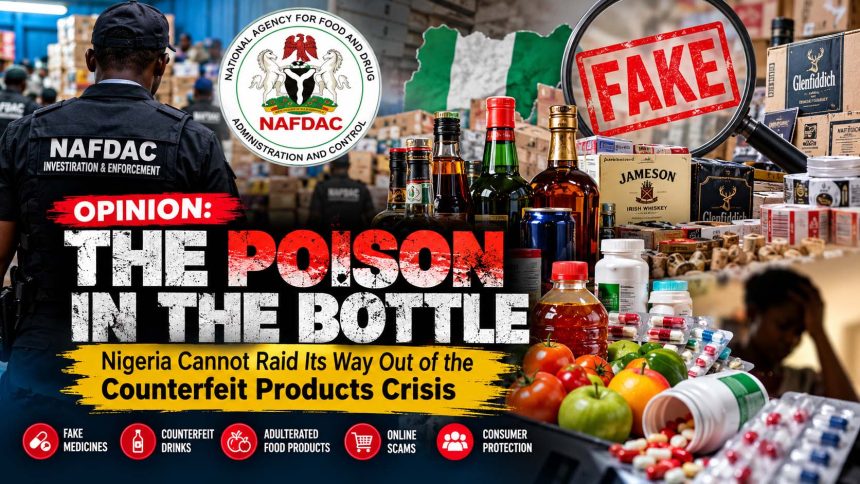
The recent enforcement operations by the National Agency for Food and Drug Administration and Control (NAFDAC) in Lagos and Aba have once again drawn attention to the dangers posed by counterfeit beverages, fraudulent packaging materials and the wider trade in potentially unsafe products.
The discoveries should concern every Nigerian, regardless of income, occupation or social status. Counterfeiting is not simply an economic crime committed against manufacturers. It is a threat to public health, consumer confidence and the right of citizens to purchase products without unknowingly exposing themselves and their families to avoidable danger.
More Read

The question is no longer whether counterfeit products exist in Nigeria. The more urgent question is whether the country is doing enough to prevent them from reaching consumers.
When a Familiar Bottle Becomes a Dangerous Gamble
At Zamfara Plaza, within the BBA Trade Fair Complex along the Badagry Expressway in Ojo, Lagos State, NAFDAC operatives reportedly uncovered a suspected illicit facility where alcoholic and energy drinks were being produced or repackaged.
The operation, which followed intelligence gathering and surveillance, reportedly resulted in the arrest of two suspects, Chibuzor Okafor and William John. Officials recovered drums, filters, packaging materials, a heating device and other equipment suspected of being connected to the operation.
More Read

During the raid, one of the arrested suspects reportedly admitted to changing the bottles in which drinks were contained, explaining that he transferred the drinks into other bottles because the original ones were damaged.
That explanation raises a fundamental question: what assurances did consumers have that the contents were genuine, safe and handled under appropriate quality-control conditions?
A bottle bearing a recognised brand name may inspire confidence. Its label may appear authentic, its packaging may look professionally produced, and its presentation may be indistinguishable from that of a legitimate product. Yet none of these features, on their own, guarantees that the contents are genuine or safe.
This is what makes counterfeit beverages particularly troubling. The danger may not be visible when the consumer makes the purchase.
A person buying a bottle of whisky for a celebration or wine for a family gathering is unlikely to suspect that the product may have passed through an unauthorised repackaging operation. Consumers ordinarily depend on established brands, legitimate retailers and regulatory institutions to provide a reasonable level of assurance about product quality.
When that trust is abused, the consequences extend beyond the immediate financial loss.
More Read

Depending on the product’s composition and the nature of any adulteration, consumers could be exposed to serious health risks. One particularly dangerous possibility is methanol contamination in alcoholic beverages, which can cause severe poisoning, visual impairment, permanent blindness and death when consumed in sufficient quantities.
However, it is important to distinguish between a suspected counterfeit product and a laboratory-confirmed toxic substance. Not every counterfeit beverage necessarily contains methanol or other dangerous chemicals. The real concern is that when products are tampered with or manufactured outside legitimate quality-control systems, consumers may have no reliable way of knowing what they are consuming.
That uncertainty alone should be enough to demand stronger preventive action.
Aba’s Packaging Market and the Business of Deception
The Lagos discovery was not an isolated development. In Aba, Abia State, NAFDAC reportedly raided shops at Old Court Road Market, recovering large quantities of labels, corks and outer packaging materials bearing the names of established beverage brands.
The brands identified in the agency’s account included Jameson, Glenfiddich, Four Cousins, Lord’s Dry Gin and Imperial Blue. Packaging materials associated with Chelsea, Squadron and Seaman’s Aromatic Schnapps were also reportedly recovered, alongside materials linked to Goya oil.
NAFDAC estimated the value of the recovered counterfeit packaging materials from five shops at more than ₦200 million.
The significance of this discovery extends beyond the value of the seized materials. Packaging is an important part of the counterfeit trade because it can help unauthorised products imitate the appearance of legitimate goods.
A counterfeit operation does not necessarily have to reproduce every aspect of a genuine product to deceive an unsuspecting buyer. Familiar labels, bottles, corks and outer cartons can create an appearance of authenticity that encourages consumers to lower their guard.
The Lagos and Aba operations therefore illustrate two potentially connected dimensions of the problem: suspected activities involving the contents of beverages and the availability of packaging materials that could be used to make unauthorised products resemble established brands.
The reported resistance encountered by enforcement officials in Aba, including threats and intimidation during the evacuation of recovered materials, also raises concerns about the difficulties regulators may face when confronting entrenched illicit commercial networks.
These developments reinforce the need to investigate not only the finished products but also the people, facilities, suppliers and distribution channels that may enable counterfeiting.
Confiscating packaging materials is necessary. Identifying the individuals financing the trade, tracing their suppliers and disrupting the channels through which counterfeit products reach retailers are equally important.
Without such follow-through, one operation may remove materials from a particular location while leaving the wider business model intact.
When Fake Medicines Turn Treatment into a Costly Struggle
Although counterfeit beverages have attracted attention, the broader challenge extends to medicines, food products, cosmetics, packaged water and other regulated goods.
The implications become particularly serious when the product involved is a medicine intended to prevent illness, control a chronic condition or save a patient’s life.
Consider a Nigerian battling malaria who takes medication but continues to experience symptoms. The patient returns to the hospital, pays for further consultations, undergoes additional tests and purchases another prescription.
Or consider a person living with hypertension who takes medication consistently but fails to achieve adequate blood pressure control.
There may be several explanations for treatment failure. The diagnosis could be incorrect, the dosage inappropriate, the patient may have difficulty adhering to treatment, or the disease may be resistant to a particular medicine. Complications and other medical factors can also influence recovery.
But another possibility deserves serious attention: the quality of the medicine itself.
A falsified or substandard medicine may contain the wrong ingredients, an insufficient quantity of the active pharmaceutical ingredient or harmful contaminants. In such circumstances, even a correctly prescribed treatment may fail to deliver the expected benefit.
The consequences can be devastating.
An illness may worsen while the underlying problem remains undetected. A patient may lose confidence in a doctor who has prescribed an appropriate treatment. A family may spend money it cannot afford on repeated hospital visits, additional investigations and alternative medication.
For people managing hypertension and diabetes, the stakes are particularly high because consistent disease control is essential to reducing the risk of complications.
Ineffective treatment can undermine that control, while unsafe ingredients may introduce additional risks.
This is why counterfeit medicines should not be treated merely as a matter of commercial dishonesty. They can undermine the relationship between patients and healthcare professionals, place additional pressure on already stretched household finances and weaken public confidence in the healthcare system.
When treatment fails, patients deserve a proper medical assessment, not assumptions. Healthcare professionals and regulators must also have effective channels for investigating suspected product-quality problems.
The public health system must be capable of distinguishing between treatment failure caused by the disease, problems associated with how medicines are used and failures arising from the quality of the products themselves.
The Vulnerable Consumer and the Promise of a Miracle Cure
The dangers associated with unsafe products are not confined to roadside markets or unregistered shops. Products promoted through online platforms, radio advertisements and other seemingly familiar channels can also expose consumers to risks.
A reported incident in Ogun State involving a young woman who allegedly purchased an advertised herbal product to treat suspected fibroids illustrates the potential consequences of trusting unverified health claims.
According to the account, the woman obtained the product through a radio programme in Abeokuta and inserted the substance as directed. She subsequently experienced severe pain and a sensation of internal blockage. Medical experts reportedly discovered that the substance was caustic soda, a highly corrosive chemical.
If confirmed as reported, the incident is deeply disturbing.
A woman seeking relief from a distressing health concern was allegedly exposed to a substance capable of causing serious chemical injury. The case raises questions about how purported remedies are advertised, how their ingredients are verified and what safeguards exist to prevent dangerous substances from being marketed for human use.
It also highlights the vulnerability of consumers who are desperate for solutions.
When specialist healthcare is difficult to access, medical bills are unaffordable or symptoms create considerable anxiety, a persuasive advertisement promising a quick cure can appear attractive. A trusted voice on the radio or a confident seller on social media may seem more accessible than a hospital consultation.
But hope must never become a tool for exploitation.
Claims that a product can cure fibroids, diabetes, hypertension or other serious conditions should be approached with caution, particularly when the seller promises miraculous results or discourages conventional medical care.
Regulatory authorities, advertising platforms, broadcasters and healthcare professionals all have a role to play in ensuring that products promoted for human use are not allowed to endanger the public through false claims or unsafe ingredients.
NAFDAC’s Enforcement Figures Tell Only Part of the Story
NAFDAC’s reported enforcement activities between January and August 2026 provide an indication of the scale of the regulatory challenge.
According to figures attributed to the agency’s Directorate of Investigation and Enforcement, NAFDAC recorded 5,542 enforcement activities, conducted 213 raids, recorded 821 product seizure entries and closed or sealed 179 premises during the eight-month period.
The agency also reportedly recorded 52 arrests, 474 newly reported cases, 295 concluded cases and 22 product destruction exercises.
The value of unsafe products destroyed was reported at approximately ₦22.73 billion.
These figures cover a broad range of regulated products, including medicines, food, beverages, cosmetics, chemicals, packaged water and medical devices. Cosmetics reportedly accounted for 401 seizure entries, drinks for 215, drugs for 112, food for 69 and chemicals for 22.
The figures are significant. They suggest an extensive enforcement workload and demonstrate why consumer protection cannot be limited to a single product category.
But they also raise an important question about how regulatory success should be measured.
The number of raids conducted is not, by itself, proof that the prevalence of counterfeiting is declining. The value of goods destroyed does not establish how many consumers were protected, how many illicit operations were permanently dismantled or whether the offenders responsible were successfully prosecuted.
Enforcement statistics are useful, but they must be accompanied by evidence of outcomes.
How many investigations resulted in convictions? How many illicit supply chains were disrupted? How quickly were suspected unsafe products identified and removed from circulation? How many complaints led to investigations and corrective action? What evidence exists that repeat offenders were prevented from returning to the market?
These are the kinds of questions that should form part of a transparent public accountability framework.
A successful regulatory system must do more than respond to violations after they have occurred. It must also reduce the opportunities for those violations to happen in the first place.
Is NAFDAC Doing Enough to Protect Consumers?
Public health expert Dr Casmier Ifeanyi, National President of the Association of Medical Laboratory Scientists of Nigeria, has questioned the effectiveness of market surveillance and post-registration monitoring.
His concerns touch on a critical principle of regulation: registering a product should not mark the end of regulatory responsibility.
Products must continue to be monitored after they enter the market. Their quality can be compromised by falsification, improper storage, contamination, unauthorised repackaging or other failures along the supply chain.
Ifeanyi also questioned why ordinary consumers sometimes appear to play a prominent role in identifying suspected counterfeit products.
His criticism deserves attention, but it must be considered alongside the enforcement operations NAFDAC says it has carried out. The Lagos and Aba discoveries themselves demonstrate that the agency is undertaking raids, making seizures and investigating suspected illegal activities.
The central issue, therefore, should not be reduced to whether NAFDAC is acting or doing nothing. It is whether its enforcement and surveillance systems are sufficiently preventive, consistent, adequately resourced and effective.
Regulators cannot physically inspect every shop, warehouse, production facility and online seller at all times. That reality makes intelligence gathering, risk-based inspections, laboratory testing, public reporting and cooperation with other institutions essential.
It also makes transparency important.
Consumers should have access to clear information about verified product recalls, confirmed safety concerns, enforcement outcomes and the appropriate channels for reporting suspected counterfeits. Where investigations are ongoing, authorities should communicate what is known without presenting allegations as established facts.
The public needs a regulator that is visible when action is required, responsive when complaints arise and accountable for the outcomes of its interventions.
Counterfeiters Are Adapting. Regulation Must Adapt Too.
The growth of online commerce has introduced another layer of complexity.
Medicines, cosmetics and other healthcare products are increasingly advertised through social media accounts, online marketplaces and informal digital networks. These channels offer convenience, but they can make it difficult for consumers to establish a seller’s identity, trace a product’s origin or determine whether the item delivered is the one originally advertised.
NAFDAC Director-General Professor Mojisola Adeyeye has reportedly acknowledged this challenge, including the agency’s efforts to monitor online sales through platforms such as Instagram, Facebook, Jiji, Jumia and Konga.
According to the account, the agency has deployed corps members and interns to monitor online product sales, with information gathered submitted for review and possible investigation. The agency has also discussed compliance measures involving online marketplaces and tools such as Scan2Verify and the Green Book for checking registered products.
These efforts are relevant, but online monitoring must be supported by effective enforcement and cooperation with the platforms through which products are sold.
A seller who is removed from one account may reappear under another identity. A listing may disappear while the same product continues to circulate through a different channel. A seemingly legitimate advertisement may direct a buyer to an untraceable supplier.
Digital monitoring must therefore be connected to physical investigations, product testing, traceability systems and appropriate legal action.
Online marketplaces should take reasonable steps to identify prohibited products, respond to credible safety complaints and cooperate with regulators. Sellers should be required to meet applicable legal obligations, while consumers should have practical ways to verify products and report suspicious listings.
Technology cannot eliminate counterfeiting on its own. But intelligently deployed technology can make it more difficult for illicit sellers to hide behind anonymous accounts and misleading advertisements.
What Must Change?
Nigeria needs a comprehensive strategy that treats counterfeit products as a public safety problem rather than merely an enforcement statistic.
First, post-market surveillance must become more effective. Product registration is not a permanent guarantee that every item bearing a particular brand or registration number is genuine. Regulators need to continue checking products in markets, pharmacies, warehouses, distribution centres and online channels.
Second, the supply chains behind counterfeiting must be investigated. Arresting individuals found at a suspected facility is important, but investigations should also seek to identify the financiers, suppliers, distributors and other participants who may sustain the operation. Packaging materials and equipment should be traced wherever the evidence permits.
Third, laboratory testing and reporting systems must be strengthened. Suspected counterfeit products should be assessed through appropriate procedures before definitive claims are made about their contents or health effects. Healthcare professionals should have accessible channels for reporting suspected adverse reactions and unexplained treatment failures that may indicate a product-quality problem.
Fourth, prosecution and accountability must follow enforcement. Raids and seizures may disrupt illegal activities, but sustained deterrence requires credible investigations, fair legal processes and appropriate penalties for proven offences. The public should receive regular updates on cases and their outcomes, subject to legal and investigative constraints.
Fifth, public education must be practical and continuous. Consumers need to know how to verify product registration through official channels, identify suspicious packaging, recognise exaggerated health claims and report suspected counterfeits. They should also understand that copied registration numbers and convincing packaging can be used to deceive buyers.
Sixth, legitimate manufacturers and distributors must strengthen product integrity. Traceable supply chains, secure packaging, effective quality control and prompt reporting of suspected counterfeiting can help protect consumers and make illicit activity easier to detect.
Finally, government must ensure that regulatory institutions have the resources and accountability mechanisms they need. Effective enforcement requires trained personnel, appropriate laboratory capacity, reliable intelligence, inter-agency cooperation and the ability to pursue complex cases.
Improving domestic pharmaceutical manufacturing may also strengthen supply-chain resilience, but local production alone will not solve the problem. Both locally manufactured and imported products must meet applicable quality standards, and every participant in the supply chain must be held to the same requirements.
The goal should be a system in which unsafe products are detected early, illicit networks are disrupted and legitimate businesses can operate without being undercut by criminal competitors.
The Consumer Also Has a Role, but Must Not Carry the Entire Burden
Consumers can take precautions, although no individual should be expected to detect every counterfeit product through visual inspection alone.
Medicines should be obtained from licensed, reputable pharmacies or appropriate healthcare providers. Buyers should be wary of unusually persuasive claims promising miraculous cures, suspiciously altered packaging, missing product information and sellers who cannot provide credible details about the products they offer.
Where available, official registration-verification tools should be used. However, a registration number printed on a package should not automatically be treated as proof of authenticity because counterfeiters may copy details from genuine products.
Consumers who suspect that a product is falsified, contaminated or associated with an unexpected reaction should seek appropriate professional advice and report the concern through relevant healthcare or regulatory channels.
Patients should not stop or change prescribed medicines, particularly those used to manage chronic illnesses, without professional guidance. Persistent symptoms or treatment failure require proper medical assessment because the cause may have nothing to do with counterfeit products.
These precautions matter, but consumer responsibility must not become an excuse for institutional failure.
A family buying food for its children should not need forensic expertise to feel reasonably confident in what it purchases. A patient collecting prescribed medication should not have to investigate an entire supply chain before taking it. And a customer buying a familiar beverage should not be left to rely entirely on the appearance of its packaging.
The primary responsibility for preventing, detecting and punishing unlawful counterfeiting rests with those who manufacture, distribute and sell unsafe or falsified products, alongside the institutions charged with regulating them.
Nigeria Must Move from Seizures to Prevention
The reported destruction of approximately ₦22.73 billion worth of unsafe products between January and August 2026 is a reminder of the scale of the challenge facing regulators. The operations in Lagos and Aba further illustrate how suspected counterfeiting can involve both the contents of products and the packaging used to make unauthorised goods appear legitimate.
But the ultimate measure of success is not how many labels are confiscated, how many buildings are raided or how many products are destroyed.
It is whether fewer dangerous products reach consumers, whether offenders are held accountable, whether illicit supply chains are disrupted and whether patients can trust the medicines on which their lives depend.
NAFDAC deserves to be assessed on the effectiveness of its work, not merely the volume of its announcements. Its enforcement operations should be sustained, while its surveillance systems, public communication, laboratory capacity and cooperation with other institutions are continually strengthened.
Healthcare professionals must report suspicious patterns and help patients obtain reliable treatment. Manufacturers, distributors and retailers must protect product integrity. Online marketplaces and broadcasters must take their responsibilities seriously when products are promoted through their channels. Government must ensure that the institutions entrusted with consumer protection can carry out their duties effectively.
Above all, the public must not be left to discover the dangers of counterfeiting through personal tragedy.
A patient whose medication fails, a family exposed to a contaminated product or a consumer deceived by fraudulent packaging may never know exactly where the system broke down. The financial losses may be difficult to recover, and the health consequences may be irreversible.
That is why the fight against counterfeit products must extend beyond market raids and destruction exercises. It must reach the point where products are manufactured, packaged, imported, distributed, advertised and sold.
Nigeria cannot afford a system that becomes effective only after dangerous products have been discovered. It needs one that makes counterfeiting harder to carry out, easier to detect and far less profitable.
The real victory will not be the destruction of counterfeit products after they have been found. It will be the protection of Nigerians from products that should never have reached them in the first place.