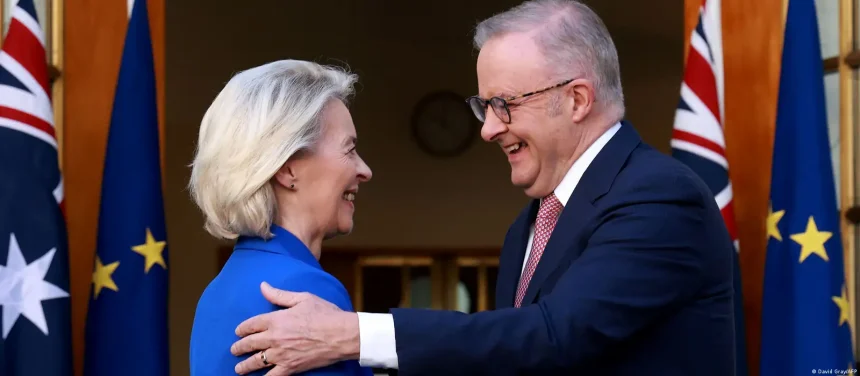
In a major breakthrough for global trade, Australia and the European Union have agreed on a sweeping free trade deal valued at approximately A$10 billion, marking the end of eight years of complex negotiations.
The agreement, signed on Tuesday, was hailed as a “win-win” by Anthony Albanese and Ursula von der Leyen, who both emphasized its long-term economic and strategic benefits.
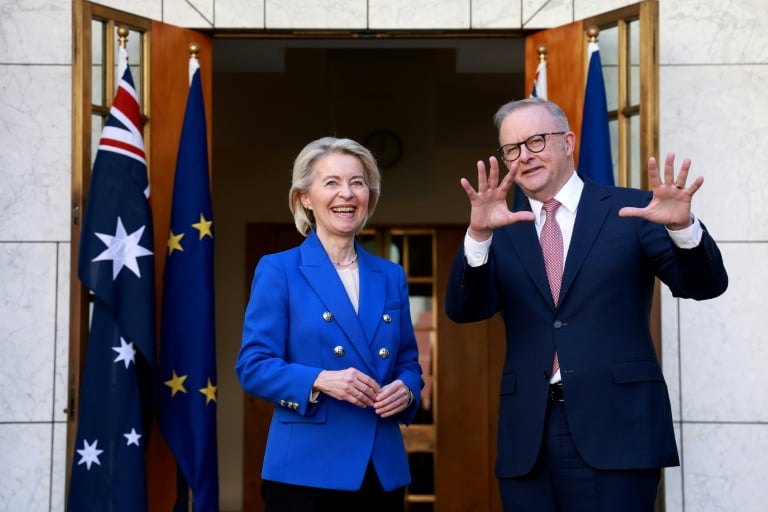
At its core, the deal eliminates nearly all tariffs on a wide range of goods traded between the two economies. Australian exports such as wine, seafood, dairy products, fruits, vegetables, wheat, and barley are set to benefit significantly, with the government estimating savings of around A$37 million for wine producers alone.
Consumers in Australia are also expected to gain, with cheaper imports of European goods including wine, spirits, chocolates, biscuits, and pasta likely to hit shelves in the coming years.
More Read
Beyond trade, the agreement reflects a deepening partnership in an increasingly uncertain global environment. Speaking after the signing, von der Leyen stressed the importance of “collective resilience” in a world where economic dependencies can be weaponized. She pointed to growing concerns over the use of tariffs and supply chain control as geopolitical tools—a subtle reference to policies associated with Donald Trump and the global influence of China in critical minerals.
A key feature of the agreement is enhanced cooperation on defence, counter-terrorism, space, and maritime security. Both sides also committed to working closely on critical mineral supply chains, particularly lithium and tungsten—resources vital for modern technologies and energy transitions.
However, not all sectors are celebrating. Australia’s red meat industry has voiced disappointment over export quotas. While the deal increases the allowable beef export quota to about 30,000 tonnes—up from just 3,389—it falls short of the 50,000 tonnes sought by producers. Meat and Livestock Australia described the outcome as a “missed opportunity” for farmers and exporters.
More Read


Another sensitive area in negotiations was food naming rights, a longstanding sticking point between Europe and its trading partners. Under the agreement, Australian producers can continue to use terms like “parmesan,” while “prosecco” may still be used domestically but will be phased out for exports over the next decade. The use of “feta” will also be gradually restricted.
Addressing the issue, Albanese highlighted Australia’s multicultural heritage, noting that many of these food traditions were brought by migrants from Europe. He described the compromise as a fair balance between protecting heritage and supporting local producers.
Von der Leyen echoed this sentiment, calling the agreement a “perfect balance” that opens markets while preserving key interests on both sides. She underscored that the partnership goes beyond economics, adding, “Trust matters more than transactions.”
As global trade patterns continue to shift amid rising geopolitical tensions, the Australia–EU deal signals a strategic alignment between like-minded partners seeking stability, diversification, and long-term cooperation.