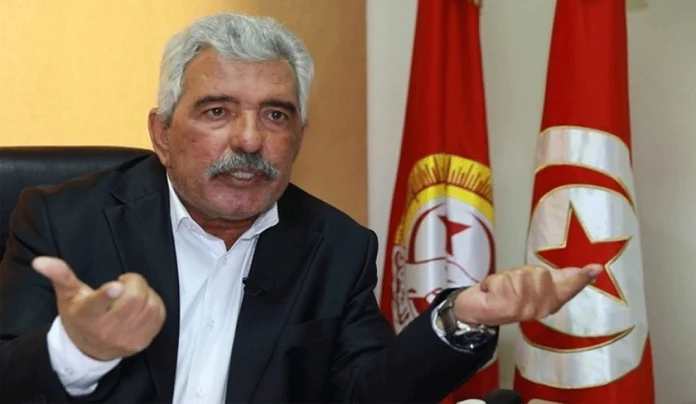
Veteran education unionist Slaheddine Selmi has been elected head of Tunisia’s influential Tunisian General Labour Union (UGTT), stepping into the role at a critical moment marked by internal rifts and strained relations with the government.
Selmi, 67, a native of Kairouan and long-time member of the primary education union, is widely viewed as a consensus candidate capable of maintaining continuity within the powerful labour confederation. Having previously served on the UGTT’s executive bureau, he brings extensive experience and familiarity with the organisation’s inner workings.

In his first remarks to Tunisian media on Saturday, Selmi signalled a conciliatory approach, pledging to restore social dialogue with the government after months of deadlock. He also outlined two key priorities for his leadership: enhancing transparency within the union and safeguarding its independence from political influence.
“I want to put social dialogue back on track,” Selmi said, emphasizing the need to rebuild trust between the union and state authorities.
More Read

However, Selmi inherits significant challenges. Deep internal divisions within the UGTT recently forced the union to hold its elective congress a year earlier than scheduled, exposing fractures among its ranks. At the same time, relations with Tunisia’s executive branch remain tense, raising questions about how quickly meaningful negotiations can resume.
The UGTT, one of the most powerful institutions in Tunisia, has long played a central role in the country’s political and social life. In 2015, it was awarded the Nobel Peace Prize alongside three other civil society organisations for its contribution to Tunisia’s democratic transition following the 2011 revolution.
More Read

Selmi succeeds a leadership era dominated by Noureddine Tabboubi, who has headed the UGTT since 2017. Speaking to Mosaique FM, Tabboubi previously said his decision to remain in office had reflected the wishes of a majority within the union’s administrative council.
As Selmi takes the helm, observers will be watching closely to see whether he can bridge internal divides and re-establish the UGTT’s role as a key mediator between workers and the state in an increasingly complex political landscape.