PARIS, France — Violent clashes between high school students and riot police have erupted across France as demonstrations over deteriorating education standards, teacher shortages and overcrowded classrooms spread to hundreds of schools.
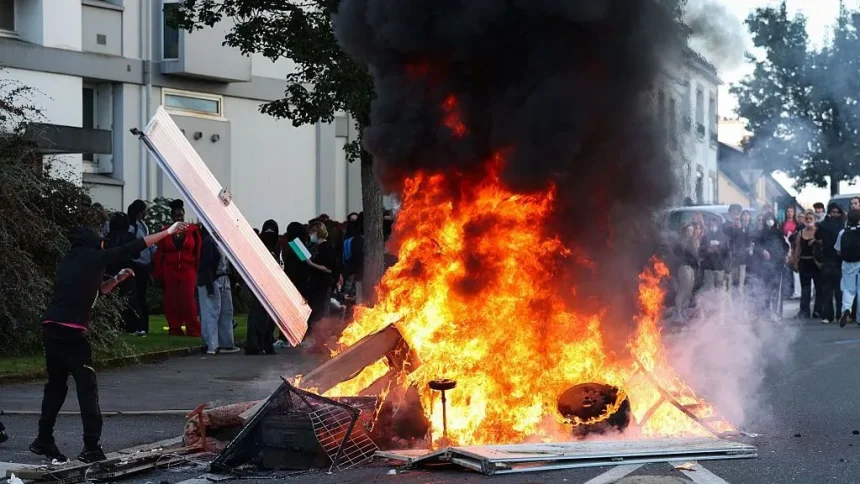
The protests, which began in the Paris region last week, have escalated into a nationwide disturbance, with fires reported in several cities and police using tear gas and other crowd-control measures.
France’s Interior Minister Laurent Nuñez said 1,747 people were arrested on Friday, while Education Minister Édouard Geffray said hundreds of schools had been affected by the unrest. Reuters separately reported that authorities had recorded around 5,000 arrests since Monday, illustrating the rapidly changing figures as the demonstrations continued.
The demonstrations have affected cities including Paris, Montpellier, Nantes, Marseille, Strasbourg, Rennes and Toulouse, with protesters blocking entrances to schools and, in some locations, clashing with police.
Justice Minister Gérald Darmanin said the situation had moved beyond ordinary student demonstrations and had become a public-order disturbance, while the government accused some non-students of joining the protests and contributing to the violence.
More Read

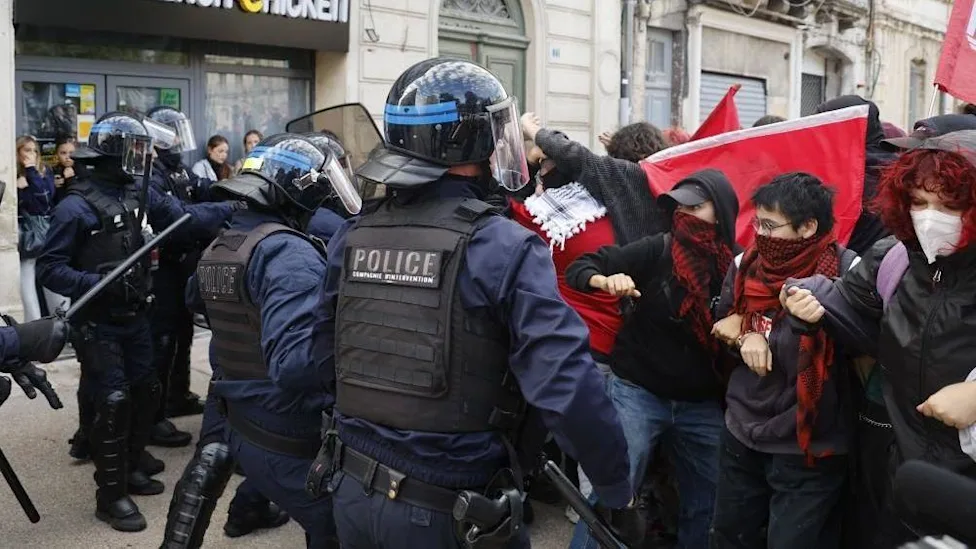
Police and protesters clash
Some of the most serious violence was reported in Belfort, in north-eastern France, where a police officer was attacked by a group of youths.
Video footage authenticated by the BBC showed the officer being chased before falling to the ground and being repeatedly punched and kicked.
More Read

Authorities have condemned the attack, while the wider protests have also generated accusations of excessive police force. French authorities have opened investigations into allegations of police violence, including incidents involving minors.
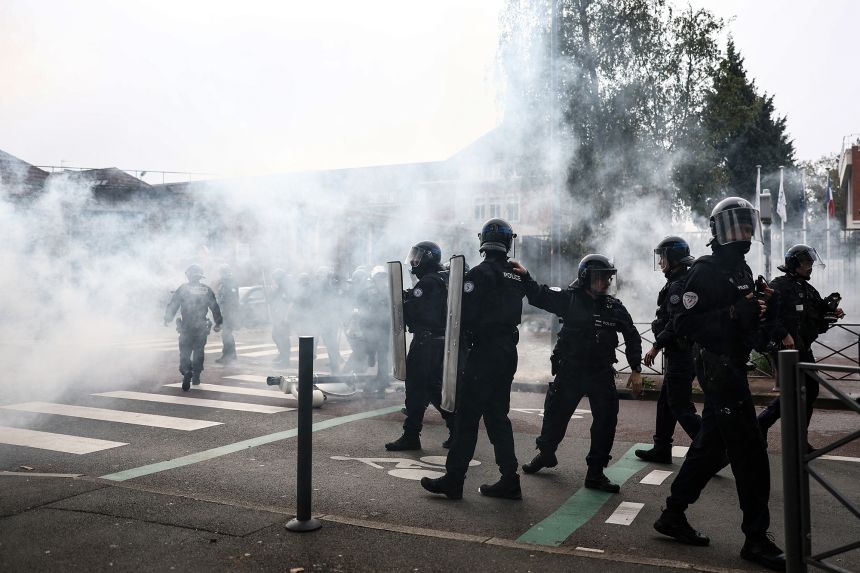
In Pantin, on the outskirts of Paris, police charged protesters after projectiles were thrown at officers. In Strasbourg, police deployed tear gas as tensions escalated, while fires were reported in Rennes and Paris.
Police have also displayed items they say were seized during the unrest, including petrol bombs, an axe and fireworks.
Schools damaged
The violence has caused significant damage to educational facilities.
The French education authorities said at least 65 members of school staff had been injured, including teachers and school principals. More than 100 high schools were also reported to have suffered severe damage.
In Nantes, the Nelson Mandela high school sustained extensive damage after fire destroyed its glass entrance and parts of the building. Regional authorities estimated the damage at more than €2 million.
More Read

The government has urged schools to switch to remote learning where necessary when protesters prevent access to school buildings.
Why are students protesting?
The students say they are demonstrating over what they describe as worsening conditions in French schools.
Their complaints include:
- Shortages of teachers and other staff
- Overcrowded classrooms
- Excessively long school hours
- Overheated classrooms
- Poorly maintained school buildings
- Insufficient classroom equipment
- Frequent staff absences
The demonstrations are also connected to anger over the government’s proposed 2027 budget, which includes a planned increase in education spending that Reuters reported would be below the rate of inflation. The proposed education budget is about €65.53 billion, excluding teacher pensions.
Students and their supporters argue that years of pressure on the education system have left schools struggling to provide adequate learning conditions.
Government demands an end to violence
French officials have acknowledged that students have legitimate concerns about education but have condemned attacks on police, teachers, school buildings and public property.
Interior Minister Nuñez said authorities were using measures to prevent the demonstrations from developing further into urban violence.
Justice Minister Darmanin has also said prosecutors should pursue parents over damage caused by their children, potentially requiring them to pay for repairs.
Education Minister Geffray said the government would introduce measures aimed at speeding up the replacement of absent teachers, while calling for students to return to classrooms.
Unions back students
Several French trade unions have expressed support for the students’ right to protest.
Teachers’ and public-service unions have called for further action, including a planned strike, as pressure mounts on the government to respond to concerns over education funding and working conditions.
Student groups have also said they intend to continue demonstrations, arguing that their demands have not yet received a satisfactory response.
Parents caught between protest and safety concerns
The escalating violence has left many parents worried about the safety of their children.
Some parents support the students’ demands for better schools, while others fear that teenagers could become caught up in increasingly violent confrontations between protesters and police.
The protests are taking place during a politically sensitive period in France, with the country preparing for next year’s presidential election. The unrest has therefore become part of a wider debate over government spending, public services and the country’s economic direction.
For now, the immediate challenge for French authorities is to restore access to schools while addressing students’ concerns and preventing further violence.
Student groups and unions, however, have signaled that demonstrations could continue in the coming days, meaning the confrontation over France’s education system may not be over.