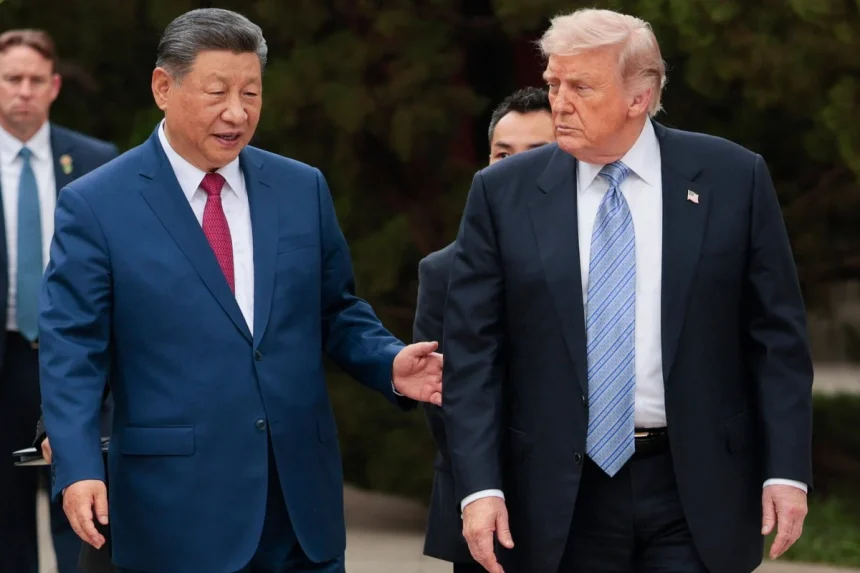
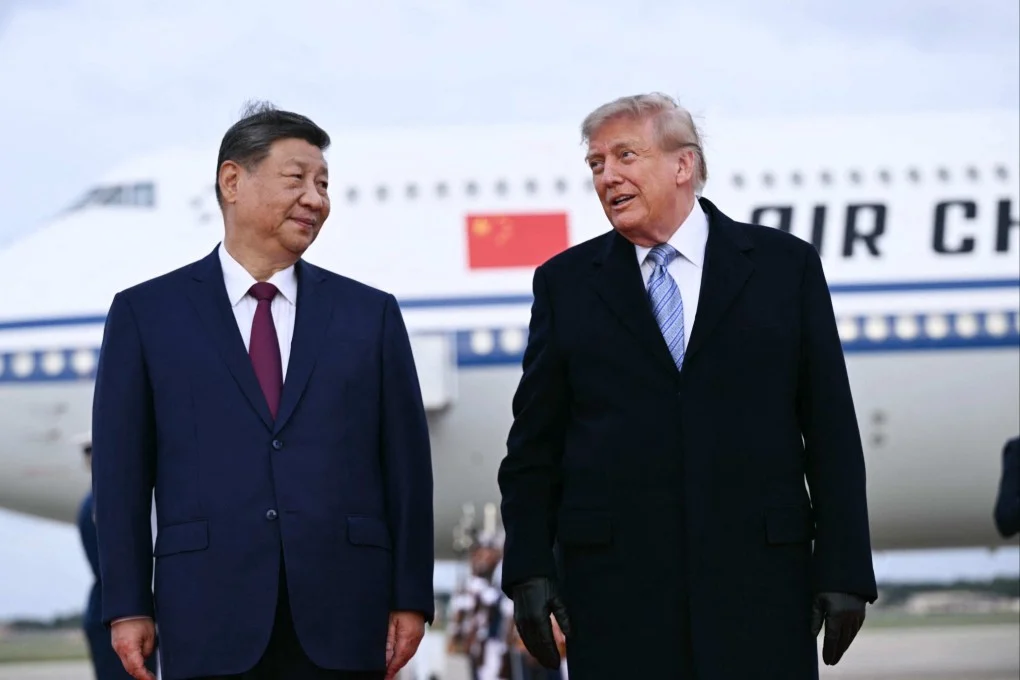
WASHINGTON — US President Donald Trump has given Chinese President Xi Jinping an unusually elaborate welcome as the two leaders begin a high-stakes three-day summit in Washington, with trade, artificial intelligence, Taiwan and the war in Iran among the major issues expected to dominate their discussions.
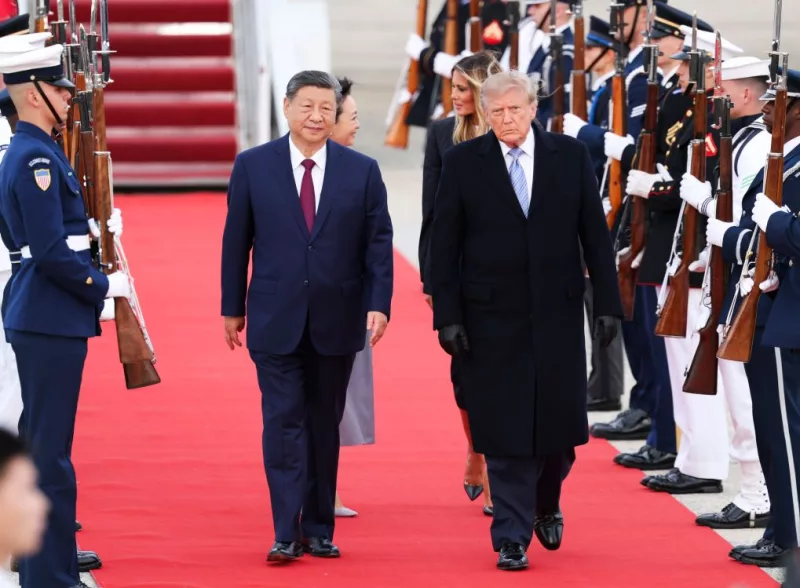
Trump and First Lady Melania Trump personally welcomed Xi and his wife, Peng Liyuan, at Joint Base Andrews in Maryland on Wednesday evening.
The Chinese leader arrived aboard an Air China aircraft at 17:39 local time, where he was met by an honour guard, the US Air Force band and American and Chinese flags. A 100ft (30m) red carpet was laid across the tarmac for the arrival ceremony.
Xi and Peng walked down the carpet alongside Trump and Melania before the two couples posed for photographs.
The ceremony also featured a military flyover by two US B-1 bombers as the Army Air Force Band played the US national anthem.
More Read
Trump’s decision to personally receive Xi at the military base marked a rare diplomatic gesture. It was reportedly the first time since 1962 that a US president had personally welcomed a foreign leader at the base. In 1962, President John F. Kennedy received British Prime Minister Harold Macmillan there.
The ceremony underscored the importance Trump has placed on Xi’s visit, which is the Chinese president’s first trip to Washington since 2015.
More Read

Trade Truce Extended
Ahead of Xi’s arrival, US Treasury Secretary Scott Bessent announced that Washington and Beijing had agreed to extend their existing trade truce until January.
The arrangement had been due to expire on 10 November and involved measures including reductions in some US tariffs on Chinese goods in exchange for Chinese steps concerning rare-earth mineral exports.
Bessent made the announcement after meeting Chinese Vice Premier He Lifeng. He said the two sides also discussed the possibility of eventually reaching a broader trade agreement.
“The two countries should be partners rather than rivals,” Bessent said.
Trade is expected to remain at the centre of Trump’s discussions with Xi, with Washington seeking greater Chinese purchases of American agricultural products and improved access to China’s rare-earth supplies.
US officials are also expected to press for additional market access for American businesses, while Beijing is likely to raise its own concerns over tariffs and US restrictions on Chinese technology.
More Read

AI and Technology on Agenda
Artificial intelligence is another major issue expected to feature prominently during the summit.
The United States and China are competing for technological leadership in AI, with both governments seeking to expand their capabilities while addressing national-security and economic concerns surrounding the rapidly developing technology.
Several American AI and technology executives are expected to attend a state dinner on Thursday.
During Trump’s visit to Beijing in May, he was accompanied by prominent US business leaders, including Apple’s Tim Cook, Tesla’s Elon Musk and Nvidia’s Jensen Huang.
It remains unclear whether Xi has brought a comparable delegation of Chinese business executives to Washington.
Taiwan Remains Sensitive Issue
Taiwan is also expected to be one of the most difficult subjects facing the two leaders.
US-China relations have long been strained by Washington’s military and political support for Taiwan, which Beijing regards as part of China.
Analyst David Firestein of the Bush China Foundation said Xi could seek to persuade Trump to delay or abandon a US arms package for Taiwan reportedly worth $14bn.
China is also expected to push for deeper economic integration with the United States while seeking relief from measures it considers restrictive.
Xi: US and China Can Coexist
In a statement carried by China’s state news agency Xinhua, Xi said China’s ambition to achieve the “great rejuvenation of the Chinese nation” could coexist with Trump’s goal of making America great again.
He expressed confidence that his visit would produce “fruitful results.”
Xi arrived in Washington accompanied by senior Chinese officials, including Cai Qi, a member of the Communist Party’s Politburo Standing Committee; Vice Premier He Lifeng; Foreign Minister Wang Yi; and other Chinese officials and diplomats.
Changing American Attitudes
Xi’s visit comes as some surveys indicate changing American attitudes towards China.
A recent Chicago Council on Global Affairs poll found that 41% of Americans viewed China’s territorial ambitions as a threat to the United States, down from 52% in 2022.
The poll also found that 57% of Americans supported greater cooperation and engagement between Washington and Beijing.
However, opinions differed among political groups, with 63% of Trump’s core MAGA supporters favoring limits on US relations with China.
The figures highlight the political tensions surrounding Trump’s increasingly high-profile engagement with Xi.
Melania Trump Plans Cultural Diplomacy
Beyond formal political meetings, the summit will also feature a cultural dimension.
Melania Trump has been closely involved in planning the itinerary and has arranged for Peng Liyuan to visit the Smithsonian’s National Museum of Asian Art.
The visit is intended to highlight cultural links between the United States and China.
The summit will conclude on Friday at the US National Archives, where Trump and Xi, accompanied by their wives, are expected to view historical records considered significant to the relationship between the two countries.
With trade, technology, Taiwan, rare-earth minerals and broader strategic competition all on the agenda, the three-day summit is being closely watched for signs of whether Washington and Beijing can move towards a more stable relationship or whether longstanding disagreements will continue to dominate ties between the world’s two largest economies.