US President Donald Trump has admitted that his administration’s aggressive immigration crackdown may have gone too far, describing its deportation policies as “too tough” following significant electoral losses suffered by the Republican Party in the midterm elections.
Trump made the remarks during an interview with CBS’s 60 Minutes, marking a notable shift in tone on one of the defining issues of his political agenda.
Although the US president maintained that he deserved an “A plus” for securing the country’s borders and reducing illegal crossings, he acknowledged that the administration’s sweeping deportation operations had negatively affected his party politically.
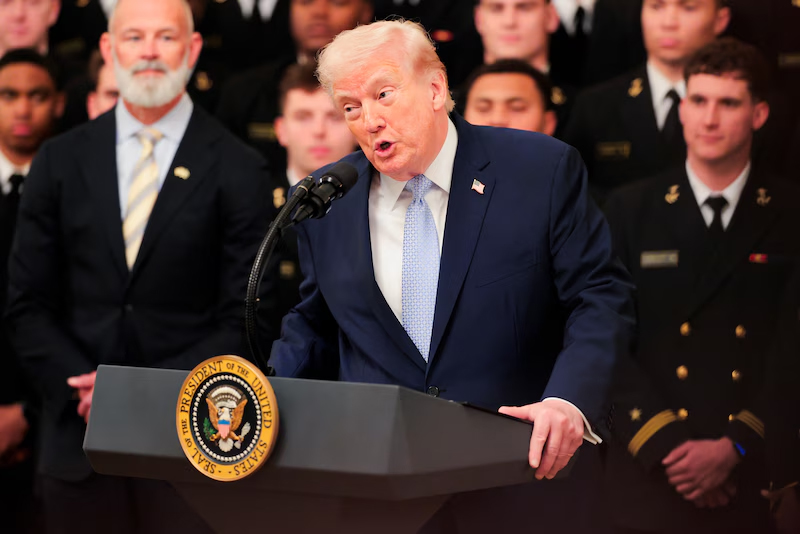
“I think I got an A plus for closing up the border,” Trump said during the interview, which aired on Sunday evening.
More Read

However, he admitted that the deportation campaign had also affected people who had established lives and employment in the United States.
“For getting people out, I get very high marks for getting the bad ones out. But I get hurt because we also took people that had good jobs, that created one violation, or breaking of the law, and that was that they came into the country illegally,” he said.
“I think it was too tough,” Trump added.
More Read

The president also expressed willingness to work with congressional Democrats on immigration reforms, saying he would “love to do something on immigration”, although he did not provide specific details about the possible areas of cooperation.
His comments represent a significant departure from his earlier position. During an interview with 60 Minutes a year ago, Trump had defended his administration’s immigration raids, insisting that enforcement efforts had not gone far enough.
The latest remarks come after Republicans suffered major setbacks in Tuesday’s midterm elections, with Democrats recording significant victories and securing landslide majorities in Congress.
Immigration was identified as the third most important issue for voters during election-day polling, behind the economy and the state of democracy.
In traditionally conservative states, including Texas, a shift in support among Latino voters towards Democratic candidates contributed to the Republican Party’s electoral difficulties.
Trump acknowledged that immigration had both helped and hurt Republican candidates during the elections.
More Read

Despite the president’s apparent willingness to reconsider aspects of his immigration strategy, there has been little indication that his administration intends to significantly reduce enforcement operations.
A White House spokeswoman told the BBC that the administration would not slow down its efforts to arrest and deport undocumented immigrants accused of criminal activities.
“The administration will not slow down its efforts to arrest and deport criminal illegal aliens who terrorise our communities,” the spokeswoman said.
Similarly, the Department of Homeland Security (DHS) maintained that Immigration and Customs Enforcement (ICE) would continue its operations.
“ICE is NOT backing away or slowing down,” a DHS spokesperson told the BBC.
Vice-President JD Vance had also indicated that the administration could consider adjustments to its immigration enforcement strategy following the election results.
In a lengthy online post reflecting on the Republican Party’s performance, Vance said he was open to changing enforcement priorities, including placing greater emphasis on businesses that employ undocumented workers.
“I’m open to the idea that we should change enforcement – by focusing more on businesses that hire illegal labour, for instance,” Vance wrote.
However, Trump’s decision on Friday to promote prominent immigration hardliner Stephen Miller to White House chief of staff has raised questions about whether the administration is genuinely preparing for a major policy shift.
Miller, widely regarded as the architect of Trump’s hardline immigration agenda during both his first and second presidencies, has played a central role in shaping the administration’s deportation and border enforcement policies.
Meanwhile, immigration enforcement operations have continued to attract controversy across the United States.
Sources within ICE told CBS that officials had recently been instructed to target approximately 2,700 arrests of undocumented immigrants daily, an increase from an earlier target of 2,000 arrests per day.
The intensified enforcement campaign has triggered protests against ICE operations in several major American cities, including Chicago, Minneapolis and Los Angeles.

In Minneapolis, two American protesters, Renee Good and Alex Pretti, were fatally shot by immigration agents, further intensifying public criticism of the administration’s enforcement activities.
Trump’s latest admission suggests growing political pressure on the White House to reconsider how its immigration policies are implemented, particularly as the Republican Party faces the consequences of its disappointing midterm performance.
However, with senior administration officials maintaining their commitment to aggressive enforcement, it remains unclear whether the president’s comments will translate into any significant changes to America’s immigration policy.