WASHINGTON/NEW YORK — Twenty-five years after the September 11, 2001 terrorist attacks forever changed the United States and reshaped global politics, Americans and people around the world have gathered to remember the nearly 3,000 lives lost in one of the darkest days in modern history.
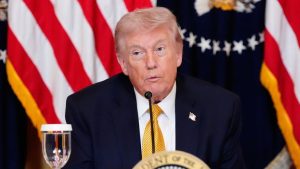
President Donald Trump led commemorations at the Pentagon, while Vice-President JD Vance attended the principal memorial ceremony at the site of the former World Trade Center in New York, where the names of those killed were read aloud.
The ceremony brought together all four living former US presidents — George W. Bush, Barack Obama, Bill Clinton and Joe Biden — along with former first ladies, families of victims and survivors.

The September 11 attacks saw hijacked commercial aircraft deliberately crashed into the World Trade Center’s Twin Towers in New York and the Pentagon in Arlington, Virginia. A fourth plane, United Airlines Flight 93, crashed into a field near Shanksville, Pennsylvania, after passengers attempted to overpower the hijackers.
More Read

The attacks killed almost 3,000 people and triggered the US-led “war on terror”, including prolonged military campaigns in Afghanistan and Iraq and years of wider American involvement in the Middle East.
Trump: “We will never, ever forget”
At the Pentagon, Trump joined senior government officials, military leaders and former Secretary of State Condoleezza Rice for a ceremony honouring the victims.
“Today we renew the sacred oath that we first swore in their names a quarter of a century ago,” Trump said, reiterating the familiar pledge that America would “never, ever forget”.
More Read

Trump also connected the legacy of the attacks to current US foreign-policy challenges, using his remarks to warn Iran that it would not be permitted to develop a nuclear weapon.
The comments demonstrated how the political consequences of 9/11 continue to influence American foreign policy a quarter of a century later.
A day remembered minute by minute
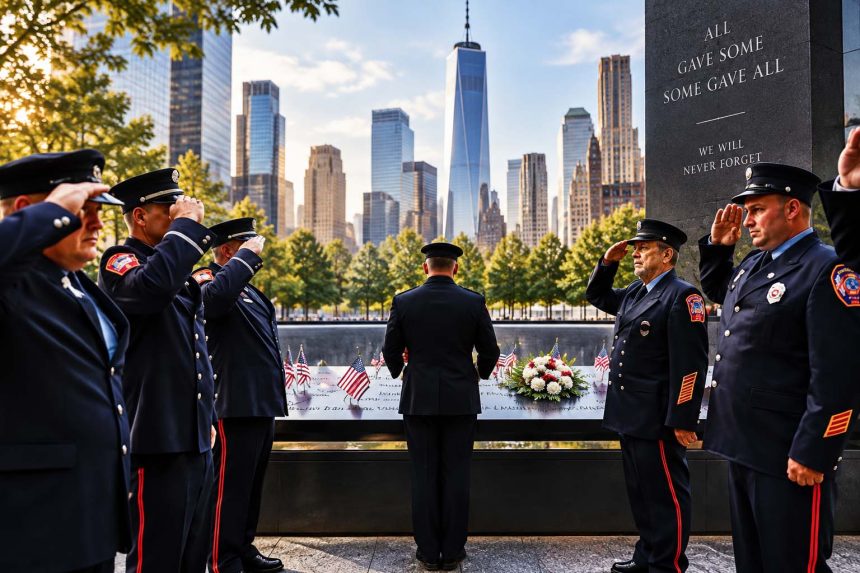
At the World Trade Center memorial, the ceremony followed the sequence of the attacks.
Moments of silence were observed at the times when the four hijacked aircraft crashed and when the Twin Towers collapsed.
The names of the victims were then read out during a ceremony lasting almost four hours.
For families who lost loved ones, the annual ritual remains deeply personal.
More Read

Among those remembering was Janice Brooks, who had moved to New York only weeks before the attacks to begin what she described as “the biggest adventure” of her life.
Brooks was working for a company on the 84th floor of the South Tower when the first plane struck the North Tower.
As she evacuated the building, the second aircraft slammed into the South Tower.
She recalled hearing an “almighty thud” and witnessing scenes of devastation as people attempted to escape.
Looking back, Brooks said she saw a huge hole where her office had been.
Her experience reflects the stories of thousands of survivors whose lives were permanently altered that morning.
A seventh bell for those who died later
This year’s commemoration carried an additional layer of remembrance.
Traditionally, six bells are rung during the ceremony to mark the moments associated with the attacks and the collapse of the Twin Towers, with each bell followed by a period of silence.
This year, organisers added a seventh bell to remember people who died in the years following 9/11 from illnesses linked to exposure to dust and toxic smoke generated by the collapse of the buildings.
US health officials say deaths from illnesses associated with the attacks have now surpassed the number of people killed on September 11 itself by more than three times.
Many first responders, rescue workers and survivors have developed serious illnesses after spending time at Ground Zero in the aftermath of the attacks.
For many families, therefore, the tragedy did not end when the towers fell.
Families continue to demand answers
While the ceremonies focused on remembrance, some victims’ relatives used the anniversary to renew demands for accountability.
Terry Strada, whose husband Tom was killed in the attacks, criticized what she described as a failure by US authorities to fully hold Saudi Arabia accountable for alleged connections to the attacks.
“You are missed more with each year that passes,” Strada said while speaking about her late husband.
“But how can it be 25 years and still we have no justice for the role that Saudi Arabia played in your murder?”
Her remarks, broadcast internationally, received applause from those attending the ceremony.
Fifteen of the 19 hijackers were Saudi nationals, while al-Qaeda founder Osama bin Laden was himself from a prominent Saudi family.
However, Saudi Arabia has consistently denied involvement in the attacks.
The 9/11 Commission, which investigated the attacks, reported in 2004 that it found no evidence that the Saudi government as an institution or senior Saudi officials funded al-Qaeda.
The issue remains a source of controversy among some victims’ families.
Remembering Flight 93
Commemorations were also held in Shanksville, Pennsylvania, where Flight 93 crashed after passengers and crew members fought back against the hijackers.
The aircraft is believed to have been heading toward a target in Washington, DC, before the passengers attempted to regain control.
Their resistance prevented the hijackers from reaching their intended destination, although the plane crashed into a field, killing everyone aboard.
The passengers of Flight 93 have since become symbols of courage and collective resistance in the national memory of September 11.
The world remembers
The 25th anniversary was not observed only in the United States.
Ceremonies were held in several countries to honour the victims and remember the international impact of the attacks.
In London, a commemorative event took place at Buckingham Palace, attended by Foreign Secretary Ed Miliband and US Ambassador Warren Stephens.
In Canada, a remembrance event was held at the Toronto Stock Exchange for colleagues who lost their lives in the attacks.
In Gander, Newfoundland, the US ambassador to Canada praised the community for its extraordinary response in the aftermath of September 11.
Thousands of passengers were stranded when dozens of international flights were diverted to Canada following the closure of US airspace.
Gander, a small community in Newfoundland, opened its doors to thousands of unexpected visitors.
“When people in America hear the word Gander, our hearts soften,” Ambassador Pete Hoekstra said.
He thanked the people of Gander and the Canadian government for their friendship and support during one of America’s most difficult moments.
Firefighters honour the fallen
In Milan, Italy, firefighters from Italy and the United States joined together for a symbolic stair climb.
Wearing their uniforms and carrying equipment, the firefighters climbed the Galfa Tower, ascending and descending 110 floors.
The number was chosen to reflect the number of storeys in each of the Twin Towers.
The event honoured the firefighters, police officers and other emergency responders who ran toward danger on September 11 while others desperately tried to escape.
Many of those first responders never returned home.

Twenty-five years later
A quarter of a century after the attacks, September 11 remains more than a historical date.
For those who lost relatives, it is a day of personal grief.
For survivors, it is a reminder of trauma and resilience.
For first responders, it is a commemoration of colleagues who made the ultimate sacrifice.
And for a generation that witnessed the attacks unfold, it remains a defining moment that changed the course of American and world history.
The attacks transformed airport security, US foreign policy, counterterrorism operations and international relations. They also launched wars and military interventions whose consequences continue to shape geopolitics today.
Yet amid the political debates and historical arguments, the anniversary ceremonies return repeatedly to one central message: remembering the people who were lost.
Twenty-five years later, their names are still being read.
Their stories are still being told.
And across the United States and beyond, the promise remains the same:
Never forget.