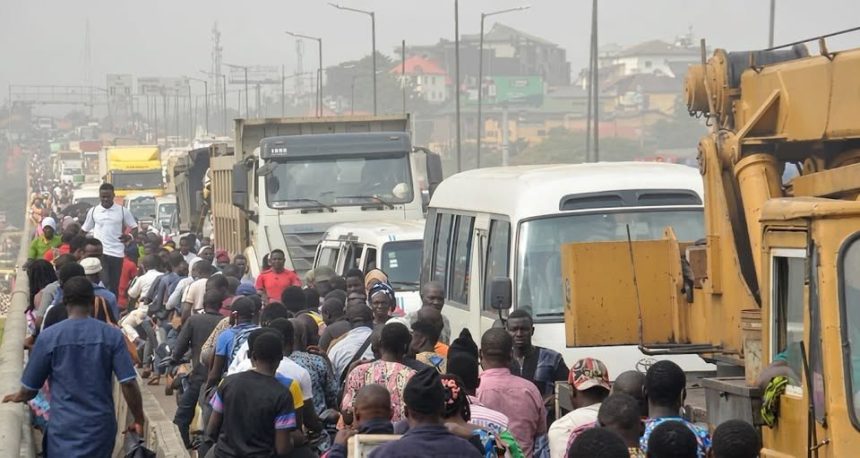
LAGOS — Motorists and commuters on the Lagos-Ibadan Expressway have been trapped in hours-long traffic as the ongoing rehabilitation of the Kara Bridge triggers severe congestion across major parts of the Lagos-Ogun corridor.
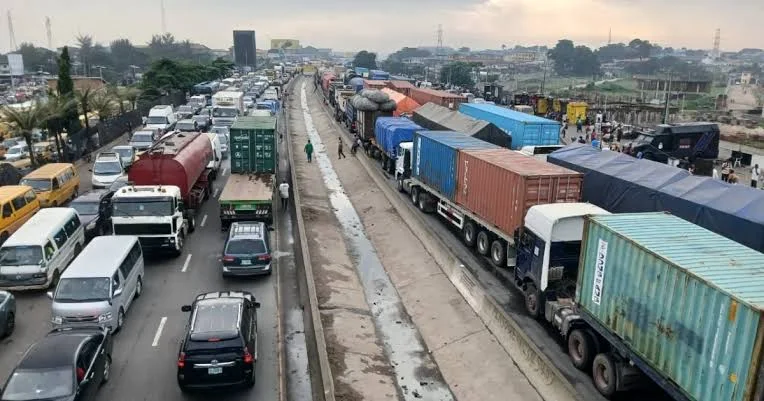
The gridlock, which worsened on Wednesday, September 9, came barely 24 hours after repair works commenced on the busy bridge, with traffic reportedly stretching from the Kara axis in Ogun State to the Toll Gate area and further into Lagos.
The two-week rehabilitation was ordered by the Minister of Works, Senator David Umahi, to replace deteriorating expansion joints on the bridge and improve its safety, structural integrity and overall traffic flow.
The project was initially scheduled to begin in August but was suspended following concerns over the short notice given to motorists and the need to strengthen traffic management arrangements before work commenced.
More Read
The Lagos State Commissioner for Transportation, Oluwaseun Osiyemi, had subsequently warned motorists to expect significant traffic disruption once the rehabilitation began.
Under the current arrangement, one half of the affected section of the bridge is closed at a time, while traffic is diverted to the available portion before the arrangement is switched.
Despite the traffic advisory, motorists experienced significant delays on Tuesday, with reports of insufficient traffic personnel at some points along the corridor.
By Wednesday, the congestion had intensified, with traffic reportedly extending beyond the Otedola Bridge and 7Up Junction and reaching deep into Lagos.
Motorists travelling towards Lagos, commuters heading to work and residents returning home were forced to spend several hours on the road.
The situation became particularly severe in the afternoon, with the gridlock stretching from the Kara Bridge axis through the Toll Gate area.
As of 4pm, traffic had reportedly moved beyond Secretariat Bus Stop, while motorists from Ikeja and Ogba attempting to access the Otedola underpass also encountered serious congestion.
Some sections around Nurudeen Olowopopo Road and Otunba Jobi Fele Way were reportedly almost at a standstill.
Several motorists complained that the available traffic management measures were inadequate to cope with the volume of vehicles using the corridor.
More Read
They also called for more effective diversion strategies and additional alternative routes to reduce pressure on the Kara axis.
A resident of Ibaafo, Ogun State, Mr Desoye Oloyede, said he left the Lagos State Secretariat at about 4pm but was forced to remain in his office because of the traffic.
“I work with the Lagos State Government. I closed and left the Secretariat at 4pm. I’m still in the office because it’s a standstill situation on the expressway.
“I have to wait till later in the day for it to subside. My vehicle engine cannot withstand the pressure of the gridlock.”
Another Lagos State civil servant, Mrs Modinat Lawal, said she had made virtually no progress on the road after leaving work.
“No movement at all. This is not too good as I have been on the road since 4pm and I am now locked around the office due to traffic.
“I was told the traffic is because of the ongoing construction at Kara Bridge. There was no adequate notice. We ought to have been adequately briefed on this development before we put our cars on the road.
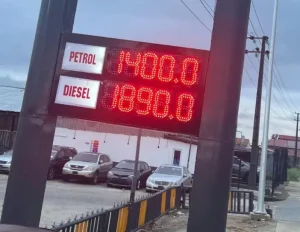
“Time and money are being lost. This is coming at a time a litre of petrol is N1,300 and here we are struggling with our vehicles in traffic, burning petrol. It’s so sad.”
A commuter, Mr Aina Abiola, who was stranded around Ojodu Berger while travelling towards Mowe, said commercial transport fares had risen sharply because of the situation.
“I didn’t leave home with extra money. I’m now stranded in Ojodu Berger as I try to get to Mowe. Commercial bus drivers have hiked fares by as much as 150 per cent.
“I am stranded and don’t have extra cash on me. I’m just hoping for a miracle to happen now.”
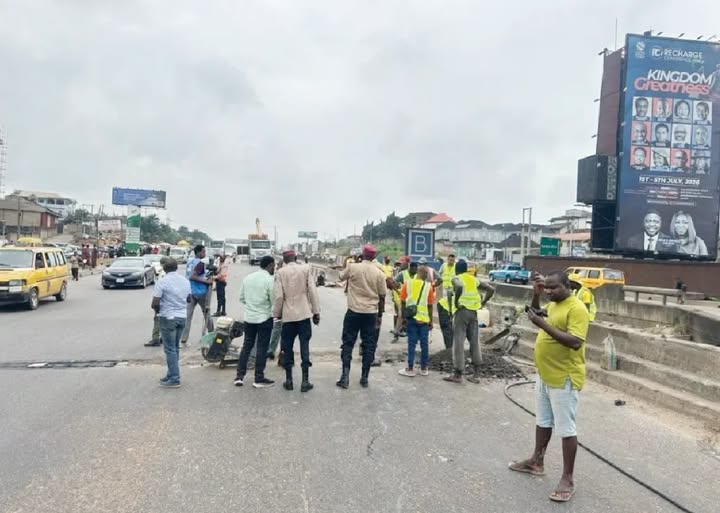
By 6pm on Wednesday, officials of the Lagos State Traffic Management Authority, LASTMA, the Federal Road Safety Corps, FRSC, and the Ogun State Traffic Compliance and Enforcement Corps, TRACE, were deployed around the Kara axis to control the situation.
The officials were seen directing vehicles approaching Kara from Isheri and Ojodu while also managing traffic on the expressway in an effort to prevent a complete shutdown of the corridor.
The expressway also witnessed a heavy influx of trucks, commercial buses and private vehicles in both directions.
LASTMA Deploys Additional Personnel
Reacting to the worsening congestion, LASTMA General Manager, Olalekan Bakare-Oki, said the agency had deployed additional personnel to improve traffic movement.
Bakare-Oki, through LASTMA Public Affairs Officer, Taofeek Adebayo, said the rehabilitation was necessary because of the deteriorating condition of the bridge and the need to prevent potential accidents.
He said LASTMA had carried out awareness and sensitisation programmes before the commencement of the repairs and deployed personnel with the support of the FRSC, Police and TRACE.
According to him, motorists were advised to obey diversion arrangements and follow the instructions of traffic management officials.
He also said alternative routes had been identified for motorists travelling into and out of Lagos.
For motorists travelling outside Lagos, he recommended using Ikorodu Road to Ikorodu Roundabout and connecting through Sagamu Road or Itokin Road towards Ijebu-Ode.
Another alternative route, he said, was the Ikorodu-Ogijo-Simawa corridor, which motorists could use to reconnect with the Lagos-Ibadan Expressway.
Motorists could also use the Lagos-Abeokuta Expressway through Sango and Ifo to Papa before connecting to the interchange.
Adebayo added that traffic personnel, including high- and medium-capacity tow trucks, had been strategically positioned along the Lagos-Ibadan Expressway to remove broken-down vehicles and other obstructions quickly.
He appealed to motorists to remain patient, stressing that the rehabilitation was expected to last for a maximum of two weeks.
“The repair works would only last for two weeks maximum. We hereby seek public patience and cooperation throughout the period of repairs,” he said.
TRACE Appeals for Patience
The spokesperson for TRACE, Babatunde Akinbiyi, also appealed to motorists to remain patient and cooperate with traffic management officials throughout the repair period.
Akinbiyi said TRACE had anticipated possible congestion and issued a traffic advisory before the commencement of the rehabilitation.
“We anticipated that there would be traffic, and that was why we issued a traffic advisory earlier.
“We can only appeal to motorists to bear with us for the time being because the repair works are necessary to ensure smooth movement and the safety of road users along the corridor.
“Anyone who does not have an important business along the axis should stay away, and those who cannot avoid using that route should cooperate with traffic officials.”
The authorities have continued to appeal to motorists to plan their journeys, consider alternative routes and avoid unnecessary trips along the affected corridor until the rehabilitation is completed.
With the repairs expected to last for two weeks, motorists and commuters using the Lagos-Ibadan Expressway may continue to experience significant delays, particularly during peak travel periods.