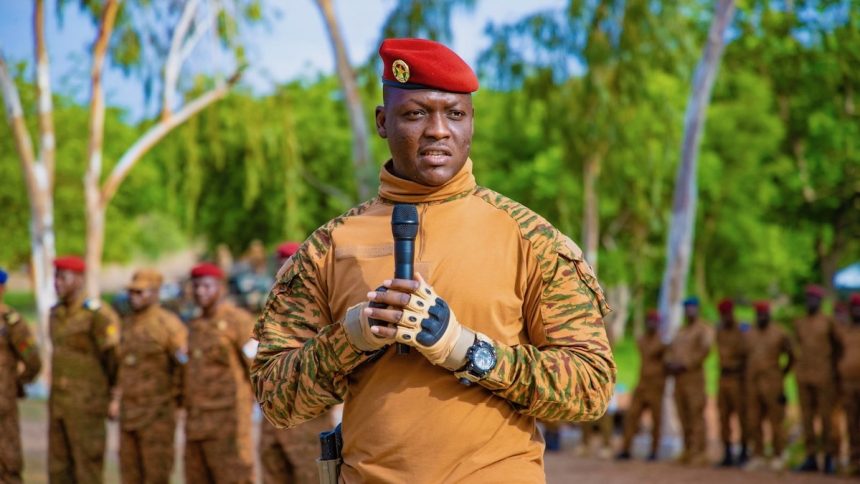
Four years after taking power, Captain Ibrahim Traoré is pursuing a vision of national sovereignty and economic independence inspired by former leader Thomas Sankara. But persistent jihadist violence, restrictions on political freedoms and a changing regional alliance present major challenges to his government.
Burkina Faso’s military leader, Captain Ibrahim Traoré, has completed four years in power, marking a milestone that draws renewed comparisons with the country’s revolutionary former president, Thomas Sankara, who also ruled for four years before his assassination in 1987.
Both military officers came to power at a young age, wearing red berets and promising to transform Burkina Faso through national sovereignty, Pan-Africanism and economic independence. However, while their political rhetoric shares similarities, the security and political circumstances surrounding their leadership are markedly different.
Traoré, who seized power in a September 2022 coup, has presented himself as a successor to Sankara’s revolutionary ideals, pledging to reduce foreign influence, strengthen domestic production and reclaim control over the country’s natural resources.
More Read
From Sankara’s Revolution to Traoré’s Economic Agenda
Sankara’s presidency from 1983 to 1987 was marked by ambitious social and economic reforms. His government prioritised education, women’s empowerment, public health, agricultural development and efforts to reduce dependence on foreign assistance. He also renamed the country Burkina Faso, replacing its former name, Upper Volta.
Traoré has adopted some of these themes, placing economic sovereignty and local industrial development at the centre of his administration’s agenda. His government has pursued greater state control over the mining sector, including the nationalisation of gold mines, while encouraging domestic production.
One of the administration’s major initiatives is Faso Mebo, an infrastructure programme designed to improve roads and urban development through the use of locally sourced materials and resources.
More Read

The programme reflects Traoré’s stated ambition to build a more self-reliant economy and reduce the country’s reliance on foreign contractors and external assistance. However, the long-term economic impact of these initiatives will depend on their implementation, funding and ability to deliver sustained benefits to the population.
Security Remains the Biggest Challenge
Despite the government’s economic ambitions, the security situation remains a defining challenge of Traoré’s presidency.
Burkina Faso has endured years of violence involving jihadist armed groups affiliated with al-Qaeda and the Islamic State. The conflict has displaced millions of people across the wider Sahel region, disrupted economic activity and placed significant pressure on the country’s security forces.
In some areas, armed groups have imposed blockades, restricting access to essential supplies and making travel increasingly dangerous. The military government has sought to strengthen its forces and mobilise civilian support in its campaign against the insurgents.
However, the continuing violence raises questions about the effectiveness of the government’s security strategy and the extent to which it can restore stability across the country.
Political Restrictions and Concerns Over Civil Liberties
Traoré’s administration has also faced criticism over its treatment of journalists, opposition figures, magistrates and civil society organisations.
More Read
Human Rights Watch has documented cases in which judicial officers were ordered to participate in military operations, while journalists and activists were forcibly recruited or abducted. The organisation has also raised concerns about the detention of government critics and restrictions on dissent.
In 2025, the government continued to face scrutiny over the conscription of people critical of the military authorities. Such measures have prompted concerns about freedom of expression, judicial independence and the treatment of individuals who challenge the government.
The authorities have justified their security measures within the context of the ongoing conflict, but rights organisations have called for the protection of civil liberties and due process.
A Shift in Burkina Faso’s International Relations
Traoré has pursued a major realignment of Burkina Faso’s foreign policy, distancing the country from France and strengthening its relationship with Russia.
The change forms part of a broader political shift across the Sahel, where military-led governments in Burkina Faso, Mali and Niger have challenged longstanding regional partnerships and sought alternative security and economic arrangements.
In January 2025, the three countries formally withdrew from the Economic Community of West African States (ECOWAS), following earlier tensions over military rule and the transition to civilian government. They have instead pursued closer integration through the Alliance of Sahel States, also known as the AES, which has developed into a regional confederation.
The three governments have also strengthened cooperation with Russia, particularly in the area of security, as they seek alternatives to their former military partnerships with Western countries.
This shift has reshaped regional diplomacy and introduced new questions about the future of security cooperation, trade and political integration in West Africa.
The Sankara Comparison: Similar Rhetoric, Different Circumstances
The similarities between Traoré and Sankara have attracted attention both within Burkina Faso and internationally. Their military backgrounds, young leadership and emphasis on sovereignty have contributed to comparisons between the two.
However, their governments have operated in different circumstances. Sankara’s revolution focused on restructuring society and the economy, while Traoré’s administration has been shaped heavily by an ongoing insurgency and the challenge of regaining territorial control.
Both periods have also involved restrictions on political opposition, illustrating the tension between revolutionary ambitions and political pluralism. Historical accounts of Sankara’s government document restrictions on political parties and the use of revolutionary committees to mobilise the population.
For Traoré, the central question is whether his government can translate its promises of national independence and economic transformation into tangible improvements in living conditions while addressing the country’s security crisis.
What Lies Ahead for Burkina Faso?
As Traoré reaches the four-year mark, Burkina Faso faces several interconnected challenges: persistent insecurity, economic pressures, the need for infrastructure development and concerns over political freedoms.
His administration’s emphasis on local production, state control of natural resources and regional cooperation has set out a distinct political and economic direction. Yet the effectiveness of these policies will ultimately depend on measurable outcomes, including improved security, sustainable economic growth and better access to public services.
The comparison with Sankara remains an important part of the country’s political conversation. But whether Traoré’s leadership will produce a lasting transformation comparable to the aspirations of the 1983 revolution remains an open question.