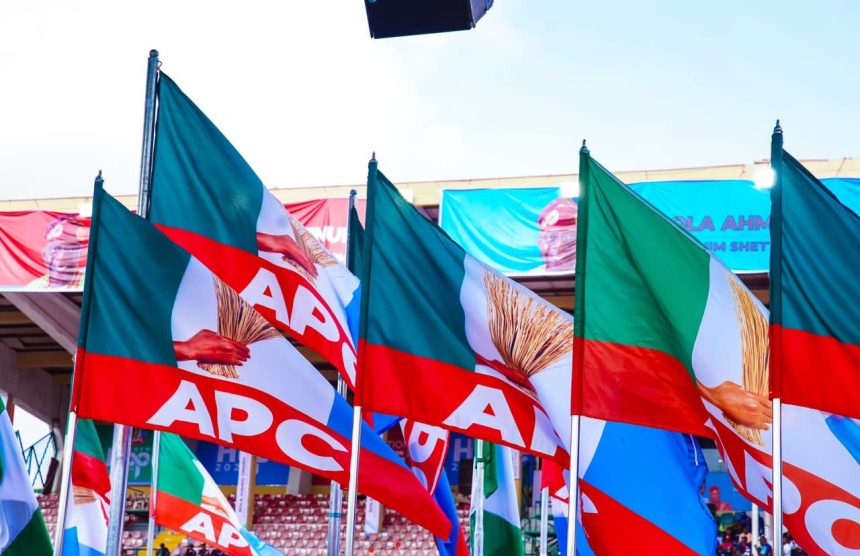
The All Progressives Congress (APC) is facing a widening post-primary crisis, with defections, internal disputes and lawsuits spreading across several states and threatening to weaken the ruling party ahead of the 2027 general elections.
Nearly four months after its 2026 primaries, efforts by the party’s National Working Committee (NWC) to reconcile aggrieved members appear to have yielded limited results in some of the worst-affected states.
The NWC moved quickly after the primaries, setting up reconciliation panels and sending peace missions to states where the exercise generated controversy. However, the interventions have failed to completely resolve the grievances of several aspirants and their supporters.
Many of the aggrieved politicians now face what they regard as a difficult choice: remain within a party where they believe their political ambitions have been frustrated, challenge the primary outcomes in court, or defect to another political platform.
At the centre of the problem is the amended Electoral Act, which has narrowed some of the options previously available to political parties for managing post-primary disputes.
More Read

In previous election cycles, defeated aspirants could sometimes be accommodated through consensus arrangements, deputy positions, negotiated political appointments and other last-minute compromises.
That room for manoeuvre has now become significantly narrower, making it more difficult for party leaders to pacify aggrieved aspirants after fiercely contested primaries.
The consequences could be significant for the APC because several of those leaving the party are not political newcomers or fringe members.
More Read

Some command established grassroots structures, loyal supporters and significant influence in their constituencies. Their departure could therefore go beyond the loss of individual members and potentially affect the party’s chances in governorship and National Assembly contests.
In closely fought states and constituencies, the movement of such political structures to opposition parties could also alter the electoral calculations for the 2027 presidential contest.
Defections Spread Across States
The cracks are already becoming visible in several states.
In Nasarawa, former Inspector-General of Police, Mohammed Adamu Abubakar, defected from the APC to the Social Democratic Party (SDP) after losing the APC governorship primary.
In Kwara, Senator Saliu Mustapha moved to the Peoples Democratic Party (PDP) after being excluded from both the governorship and senatorial contests. His movement has also raised concerns within the APC because of the political structure and supporters associated with him.
Bauchi has witnessed a similar development, with Senator Shehu Umar Buba leaving the APC after losing the governorship primary.
More Read

His defection was followed by the movement of APC Deputy State Chairman Ibrahim Misau and some ward and local government officials out of the ruling party.
In Cross River, federal lawmaker Alex Egbona also defected from the APC to the PDP as he seeks another term in the House of Representatives.
Osun Dispute Remains Unresolved
The situation in Osun State remains unsettled.
Senator Iyiola Omisore has rejected reconciliation overtures following his exclusion from the APC governorship primary.
About 20 of his loyalists have reportedly defected to Accord, further exposing the depth of the disagreement within the party.
The development has heightened concerns that the APC could lose some of its existing political structures ahead of the 2027 elections if efforts to bring the aggrieved camp back into the party fail.
Ondo Crisis Moves to Court
In Ondo State, the disagreement has moved beyond internal party negotiations and into the courtroom.
Several aspirants linked to Governor Lucky Aiyedatiwa have instituted legal actions against the APC and the Independent National Electoral Commission (INEC) over the outcomes of some of the party’s primaries.
Among those challenging the process is Pastor Akingboye Akinleke David, who is contesting the emergence of Donald Ojogo as the APC candidate for the Ilaje/Ese-Odo Federal Constituency.
Sources familiar with the dispute told Daily Sun that Governor Aiyedatiwa’s political camp financed nomination forms for some of the aspirants who are now challenging the primary outcomes in court.
Political observers have warned that the prolonged dispute could weaken the APC’s position in the constituency and create an opportunity for opposition parties to gain the seat if the crisis remains unresolved.
Reconciliation Under Pressure
Party insiders have privately acknowledged that what initially appeared to be isolated grievances has developed into a broader pattern across several states.
Although reconciliation committees are continuing their engagements with aggrieved members, multiple lawsuits challenging primary outcomes remain pending.
The unresolved cases could prolong uncertainty over the identities of some APC candidates as political parties begin preparations for the 2027 campaigns.
For the APC, the development presents a particularly uncomfortable political irony.
The party’s emergence as a dominant national political force was significantly aided by large-scale defections from rival parties, particularly ahead of the 2015 elections.
More than a decade later, the same political weapon that once helped the APC weaken its opponents is increasingly being turned against the ruling party itself.
With the 2027 elections drawing closer, the ability of the APC leadership to reconcile its factions, retain influential politicians and prevent further defections could prove crucial to its attempt to maintain its grip on power.