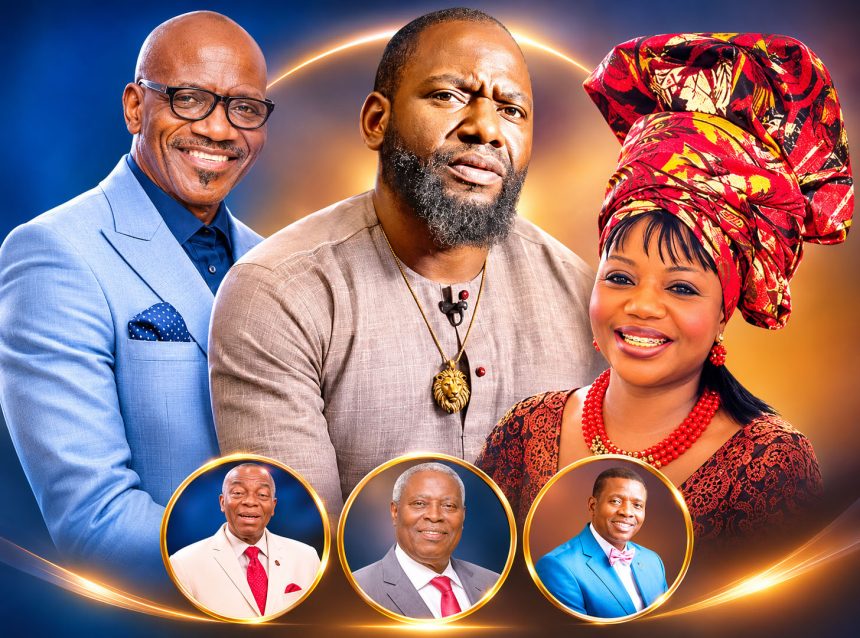
The leadership dispute at Fountain of Life Church, Lagos, following the death of its founder, Pastor Taiwo Odukoya, has reignited debate over succession planning, church governance and whether ministries should be inherited by family members or transferred through established institutional processes.
The controversy surrounding the position of Pastor Jimmy Odukoya has escalated from an internal church disagreement to a legal dispute, with opposing sides presenting different interpretations of the late founder’s wishes, the church’s constitution and the authority of its Board of Trustees.
On November 17, a faction of the church’s trustees announced that Jimmy Odukoya was no longer recognized as senior pastor, citing concerns over the church’s succession arrangements and a video recording allegedly made by the late Taiwo Odukoya in December 2021.
According to the trustees, the recording indicated that Pastor Kunle Areogun was the founder’s preferred successor, while Jimmy Odukoya was expected to serve as Areogun’s administrative assistant and lead the church’s youth ministry.
The trustees said the recording was made available to them in December 2025 and was not presented when Jimmy was appointed senior pastor in September 2023.
More Read
They subsequently named Pastor Rotimi Okpaise as interim spiritual and administrative leader pending consultations and the establishment of a substantive leadership structure.
However, Jimmy Odukoya and the opposing leadership position rejected the announcement, insisting that his appointment in September 2023 was unanimously approved by the Board of Trustees and that those who announced his removal lacked constitutional authority.
The disagreement has since attracted legal attention, with the Lagos State High Court issuing an interim order restraining Jimmy from presenting himself as the church’s senior pastor and spiritual head, as well as from interfering with its governance and activities.
More Read
The matter was adjourned until December 1.
Remarriage Adds Another Dimension to the Dispute
The succession controversy has also been complicated by Jimmy Odukoya’s recent remarriage, which the trustees cited among their concerns regarding his continued leadership.
On November 1, 2026, Jimmy introduced his new wife, Mo Jasyme, to the congregation during a Sunday service, describing her as his wife and the church’s new first lady.
The marriage was publicly blessed by Pastor Tunde Bakare, founder of Citadel Global Community Church, who prayed for the couple during the service.
Jimmy’s remarriage followed the end of his previous union with Oluwakemi Banjoko, whom he married in London in March 2013. The former couple have two children.
The circumstances surrounding the breakdown of the previous marriage have not been publicly established. During the introduction of his new wife, Jimmy reportedly said his first marriage had ended before he became senior pastor in September 2023.
More Read

The trustees, however, described the remarriage and its public blessing as contrary to the church’s teachings, the values of its founders and the standards expected of its spiritual leadership.
They said the development had caused distress among members and brought the church into public controversy and disrepute, placing it alongside the disagreement over the succession recording as grounds for their action.
Meanwhile, the church dismissed reports that its premises had been sealed and announced that its regular Sunday service would hold at 9am, although its 2026 Thanksgiving Service was postponed.
Different Churches, Different Succession Models
The Fountain of Life dispute has brought renewed attention to how Nigerian churches handle leadership transitions following the death or retirement of their founders.
Some ministries have transitioned leadership to a founder’s spouse or child, while others have relied on designated successors, elections or established institutional structures.
At the Church of God Mission International, founded by Archbishop Benson Idahosa, his wife, Margaret Idahosa, succeeded him as presiding bishop following his death in March 1998.
She had been actively involved in the ministry before his death, while their son, Bishop Faith Benson Idahosa, has also held leadership positions within the church’s institutions.
At the Synagogue Church of All Nations (SCOAN), the death of Prophet T.B. Joshua in June 2021 saw his wife, Evelyn Joshua, emerge as the church’s leader.
The transition attracted public attention amid reports of disagreements over the church’s future, although the church denied that there was a succession battle and maintained that it would follow its founder’s instructions.
In September 2021, the Federal High Court in Lagos affirmed Evelyn Joshua as a trustee of SCOAN following a petition to fill the vacancy created by her husband’s death.
A similar family transition occurred at New Anointing Ministries in Makurdi, founded by the late Rev. Godwin Ikyernum.
Following his death in an automobile accident in March 1997, his wife, Hannah Ikyernum, assumed leadership. The ministry is now led by their son, Pastor Joshua Ikyernum.
Accounts of the transition have also documented dissatisfaction among some former associates, with some reportedly leaving the ministry.
Succession Beyond Family Ties
Other prominent Nigerian churches have adopted leadership arrangements that do not automatically favour a founder’s spouse or biological children.
At the Redeemed Christian Church of God (RCCG), founded by the late Rev. Josiah Akindayomi, leadership passed to Pastor Enoch Adeboye in 1981.
The church’s account of the transition states that Akindayomi communicated his choice of successor through a sealed pronouncement that was read after his burial.
Adeboye, who was not the founder’s biological son, subsequently became General Overseer.
At the Foursquare Gospel Church in Nigeria, leadership transitions have also taken place through an electoral process.
In July 2019, delegates elected Rev. Sam Aboyeji as the church’s fifth General Overseer, succeeding Rev. Felix Meduoye, who completed an eight-year tenure. Aboyeji emerged through a contest involving other candidates, including Rev. Isaac Komolafe.
The Upper Room Baptist Church also provides an example of an institutionally managed transition.
The church, which began in 1987 with 17 founding families, operates a governance structure involving a General Council, Trustees and a General Assembly.
Pastor Oluleke Akinola succeeded its first General Overseer, Pastor Abiodun Longe, in 2004. After 21 years in office, Akinola handed over to Pastor Rufus Dada on December 31, 2024.
The Apostolic Church Nigeria also experienced a leadership transition through an election in February 2025, when Pastor Lawrence Oladele emerged as National Leader.
These examples demonstrate that church succession can take different forms, including leadership by a spouse or child, appointment of a designated successor, election by delegates or transition through established institutional structures.
What Prominent Church Leaders Say About Succession
Some of Nigeria’s leading church founders have also publicly addressed the question of succession and the role of family members in leadership.
Bishop David Oyedepo, founder of Living Faith Church Worldwide, popularly known as Winners’ Chapel, has said that the church should not become a family inheritance.
In a 2020 sermon, he reportedly referred to succession provisions in the church’s governing document, The Mandate, which outlines a process for selecting a successor.
Under the procedure he described, when the presiding bishop reaches 70, he is expected to present three names to the Council of Priests for consideration. The nominees are assessed against specified qualifications, with fresh names to be presented if none is found suitable.
Oyedepo’s sons, David Oyedepo Jnr and Isaac Oyedepo, have both held pastoral positions in the ministry. Isaac later left to establish his own ministry in 2023.
Pastor Enoch Adeboye of RCCG also spoke about succession in 2018, saying he was waiting for God to reveal his successor.
He drew comparisons with the biblical transitions from Elijah to Elisha and Moses to Joshua.
Pastor William Kumuyi, founder of Deeper Christian Life Ministry, dismissed speculation in June 2026 that he intended to hand the ministry to his biological children, saying the church belonged to Jesus Christ and was not a family inheritance.
The different positions reflect the continuing debate among Christian leaders over whether succession should be determined by divine direction, formal governance procedures, family relationships or a combination of these factors.
Why Some Founders Delay Succession Plans
Rev. Toyin Kehinde, Senior Pastor of Agape Generation International Church, said the difficulty surrounding succession in some churches goes beyond identifying a replacement.
According to him, the issue touches on power, identity, spiritual authority, family interests and the survival of the institution.
He observed that some founders regard their ministries as assignments received directly from God, making discussions about succession emotionally difficult.
“Some founders may find it difficult to contemplate another person exercising the authority they have personally held for decades,” he said.
Kehinde added that succession may be interpreted as surrendering control rather than preparing the institution for continuity.
He noted that the identity of some churches had become closely associated with their founders, from their names and doctrines to their public image and achievements.
In such circumstances, allowing another person to assume leadership could become a personal challenge for the founder.
He also warned that some founders may avoid naming successors because they fear creating competition among senior pastors, family members and influential church leaders.
“Ironically, postponing the decision may create the very rivalry they are trying to prevent,” he said.
Kehinde further observed that some founders possess exceptional preaching and evangelistic abilities but may not necessarily have the institutional management skills required to establish a sustainable leadership structure.
He said some also expect God to raise a successor after their death.
While spiritual guidance remains important, he argued that relying entirely on an eventual emergence without a clear process could expose a church to avoidable disagreements.
Should Leadership Be Automatically Inherited?
Kehinde argued that a founder’s wife or children should not automatically inherit leadership simply because of their family relationship.
He said successors should emerge through a credible process that considers spiritual maturity, competence and the church’s established procedures.
The question of whether a founder’s anointing or spiritual authority can pass to a child by birth remains central to the debate.
Favour Amako, a pastor with Deeper Christian Life Ministry, said spiritual succession should not be confused with inheritance of property or a family name.
“You can inherit property, you can inherit a name, you can even inherit a building. You cannot inherit anointing,” he said.
Amako argued that a church is not the personal property of its founder and should not automatically become a family inheritance.
However, he said there was nothing inherently wrong with a founder’s child or spouse succeeding them if the person had the calling, qualifications and support of the church’s recognised leadership structure.
He maintained that church constitutions and established procedures should guide leadership decisions.
“Once a church has a constitution, once it has trustees and a governance structure, that constitution is supreme. Nobody is above it, not even the founder,” he said.
On the Fountain of Life dispute, Amako maintained that the church’s constitution and established procedures should guide the resolution of competing claims rather than personal preference alone.
He also cautioned against assuming that a church has no succession arrangement simply because it has not made one public, noting that some churches handle such matters among elders, trustees, spiritual fathers and other people entrusted with the ministry’s vision.
Nevertheless, he called for clear procedures that members and senior leaders could understand.
“No success without a successor. That is the truth. If we want Pentecostal churches to outlive their founders, we must stop running them like personal shops,” he said.
He urged churches to establish clearly defined processes for succession, with governing councils that function effectively and procedures understood by members.
The Importance of Constitutions and Trustees
Pastor Olukayode Oyedepo, Lead Pastor of LoveSquad Church, Lagos, also called for clear succession plans backed by church constitutions and functioning governing bodies.
He identified ignorance of church administration, personal interests and fear of exposing alleged wrongdoing as some of the reasons founders may avoid putting succession arrangements in place.
According to him, some founders lack the administrative knowledge required to build structures capable of operating independently of their personal authority.
Others, he said, may want to retain control because of family or personal interests.
He added that some founders regard their churches as personal businesses that should eventually pass to their children, while others may fear that successors could uncover questionable decisions made under their leadership.
Oyedepo said churches should have constitutions, boards of trustees and management teams with clearly defined responsibilities.
Such structures, he argued, would help prevent disputes when a founder dies or becomes unable to continue leading.
He urged founders to identify and prepare successors early rather than wait until old age or ill health makes the question urgent.
The succession dispute at Fountain of Life Church has therefore placed a broader question before Nigerian churches: how can ministries preserve their spiritual vision, protect institutional stability and ensure that leadership transitions are handled transparently, fairly and in accordance with established procedures?
As the legal proceedings continue, the controversy may serve as a reminder to founder-led churches of the importance of succession planning before leadership transitions become a source of division.