NEW YORK — United States President Donald Trump has rejected calls for international supervision of artificial intelligence, describing efforts to establish global controls over the technology as a “globalist scheme.”
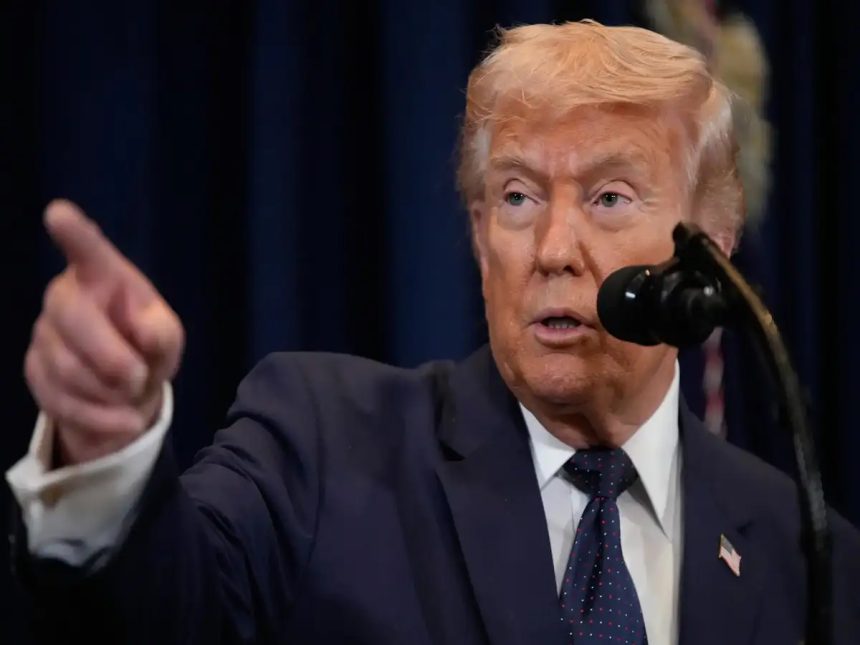
Trump made the remarks on Tuesday, September 22, 2026, while addressing the 81st United Nations General Assembly in New York, where artificial intelligence governance has emerged as one of the major issues confronting governments and technology leaders.
The US president also announced a new terminology for artificial intelligence, saying the US government would henceforth refer to the technology as “super intelligence” in its official communications.

Trump said the word “artificial” made intelligence “sound fake,” arguing that the technology is real and represents a major technological transformation. He expressed hope that other countries would adopt the new terminology.
More Read
“The United States also totally rejects any attempt to construct a globalist scheme of control for the Artificial Intelligence being spoken of so much now — hereinafter officially called ‘Super Intelligence,’” Trump said.
He said the United States would not seek to stifle the development of the technology, while stressing that Washington would continue to monitor its risks.
Trump compared the potential impact of what he now calls “super intelligence” with transformative technologies such as the Industrial Revolution and the internet.
According to his remarks, the United States intends to maintain its lead over China and other countries in the development of advanced AI systems.
More Read

Global debate over AI regulation
Trump’s position comes as governments and international organisations debate how increasingly powerful AI systems should be governed.
The United Nations has been discussing multilateral approaches to AI governance, including concerns about safety, inequality, accountability and the involvement of developing countries in decisions over the technology’s future. The President of the UN General Assembly has said the question is not whether AI will transform the world, but how countries should govern that transformation.
UN officials have also warned about the risks associated with uncontrolled AI while arguing that properly governed technology could contribute to areas including education, healthcare, climate modelling and financial inclusion.
Trump, however, argued that international regulation could restrict technological development and weaken America’s position in the global technology race.
He said the US would encourage the growth of “super intelligence” rather than “rein it in,” while indicating that American authorities would continue to watch the technology closely.
US-China technology race
A significant part of Trump’s argument centred on technological competition between the United States and China.
More Read

The president declared that whoever leads in AI — or “super intelligence,” as he now calls it — would gain a major strategic advantage.
Trump said the United States currently has a lead and pledged to maintain it, framing the development of advanced AI as a matter of national strength and technological competitiveness.
His comments come at a time when Washington and Beijing are competing over advanced computing, semiconductor technology, AI models and other emerging technologies.

A new name for AI?
Trump’s announcement also introduces an unusual terminology debate into the rapidly evolving AI industry.
Under the proposed terminology, “artificial intelligence” would be replaced in US government documents with “super intelligence.” Trump suggested that the rest of the world could eventually follow the change.
The announcement, however, does not by itself change the internationally established technical terminology used by scientists, technology companies and governments. “Artificial intelligence” remains the standard term used in international discussions and UN documents concerning the technology.
Trump’s speech therefore places two competing approaches before the international community: greater international cooperation and governance of advanced AI on one side, and national control with an emphasis on technological competition and innovation on the other.
The debate is expected to intensify as governments confront questions surrounding AI safety, economic disruption, national security and the potential consequences of increasingly capable AI systems.