The Igbo Leaders of Thought have called for the temporary suspension of Nigeria’s 2027 general elections until the country completes a proposed restructuring exercise, advocating a new 10-region political arrangement and constitutional reforms.
The group, which made its position public in a statement dated September 16, 2026, also demanded the unconditional release of detained Indigenous People of Biafra (IPOB) leader, Nnamdi Kanu, and called for a referendum to allow Nigerians determine the country’s future political and constitutional structure.
The leaders said the restructuring process should be concluded before May 2027, after which elections would be conducted under the proposed new constitutional arrangement.
Their demands were contained in a statement titled “Igbo Position on the Restructuring of Nigeria,” signed by prominent representatives of the Igbo delegation and published in newspapers.
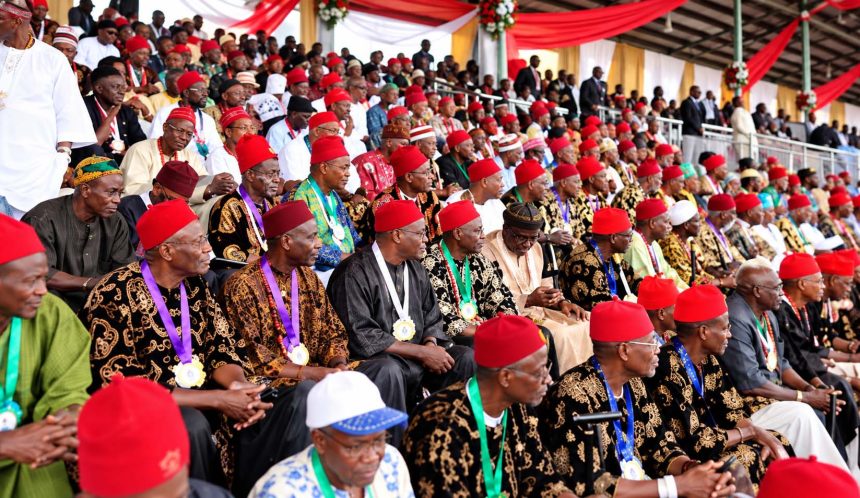
Those who signed the document included Emeritus Professor Elochukwu Amucheazi, President-General of the Igbo Leaders of Thought (ILT); Senator John Azuta-Mbata, President-General of Ohanaeze Ndigbo; Professor Dozie Chukwuokolo, Secretary-General of ILT; Ambassador Uche Ajulu-Okeke, adviser to the Igbo delegation; Dr Katchi Ononuju, deputy leader of the delegation; and Professor Obasi Igwe, leader of the Igbo delegation to the Abuja restructuring conference.
The group also rejected the communiqué issued at the Abuja restructuring conference held on August 20, 2026, and presented its own proposals for a fundamental reorganisation of the country.
Calls for Elections to Be Put on Hold
At the centre of the ILT’s proposals is its demand that the 2027 general elections be temporarily suspended to allow sufficient time for the restructuring exercise.
The group argued that Nigeria should first establish a new political and constitutional framework before conducting another round of elections.
“Duration of restructuring exercise should conclude before May 2027, with elections temporarily put on hold by an act of necessity, and resumed on post-restructuring principles,” the statement read.
The leaders maintained that the proposed reforms should provide Nigerians with an opportunity to determine the type of political arrangement they want through regional or nationwide referendums.
They also called for the right to self-determination for all ethnic nationalities, regardless of population size, and advocated a political structure built around ethno-linguistic and cultural groupings.
The proposal comes less than four months before the scheduled 2027 general elections, raising questions about the practical and constitutional implications of postponing the polls to accommodate the restructuring process.
Proposed 10-Region Political Structure
The ILT proposed replacing Nigeria’s existing states, local government areas and geopolitical zones with 10 autonomous regions, comprising five coastal regions in the South and five riparian regions in the North.
According to the group, the proposed arrangement would be based on single ethnic nationalities or consenting multi-ethnic communities, with the regions exercising greater control over their political, economic and security affairs.
A central component of the proposal is the creation of a united Igbo Region extending to the Atlantic coast. The proposed territory would incorporate Abia, Anambra, Ebonyi, Enugu and Imo states, the prospective Anioma area, Rivers State and Igbo communities in parts of Akwa Ibom, Bayelsa, Benue, Cross River, Edo and Kogi states.
The leaders argued that the proposed territorial arrangement should recognise the cultural and linguistic connections of Igbo communities across existing state boundaries.
They also proposed that all southern regions should have contiguous access to the Atlantic coast and retain their traditional coastal ports, while northern regions should border either the Niger or Benue rivers.
The group further suggested that the three proposed Middle Belt regions could merge into one or two, while some parts of the South could merge with the proposed Igbo or Yoruba regions to create larger eastern or western regions and reduce the overall number of regions.
Demand for Resource Control
On economic restructuring, the Igbo leaders called for the transfer of ownership and control of natural resources to the proposed regions, which would contribute agreed revenues to the federal government.
“Resource ownership and control reverts to the Regions, which would fund the centre on agreed terms,” the statement declared.
The proposal would significantly alter the existing federal revenue and resource management arrangements by giving the regions greater responsibility for their economic development and financial obligations to the centre.
The group also advocated a mixed private-public free enterprise economy, arguing for an economic framework that would allow private businesses and public institutions to operate within the restructured federation.
Regional Police and Security Reorganisation
The ILT also called for a comprehensive reorganisation of Nigeria’s military and security architecture to establish a balance among the proposed regions.
It maintained that regional police forces should form only one part of a broader security arrangement, rather than serve as the sole measure of decentralisation.
“Military-security reorganization to achieve security balance between Regions, of which Regional police is only one element,” the statement said.
The leaders argued that the restructuring of security institutions should be designed to accommodate the proposed regional arrangement and address the security needs of the different constituent communities.
Proposed Changes to Legislative Powers
On the distribution of legislative authority, the group proposed abolishing the concurrent legislative list, with exclusive legislative powers retained by the federal government and residual powers assigned to the regions.
The proposal would give regional governments greater authority over matters not specifically reserved for the federal government, potentially changing the balance of responsibilities between the two levels of government.
The ILT also called for a secular political system, insisting that religion should be separated from the state and political affairs.
It said the proposed constitutional framework should be built around the principle of self-determination for ethnic nationalities and the consent of communities participating in the new political arrangement.
Igbo Leaders Demand Nnamdi Kanu’s Release
The restructuring demands were accompanied by a renewed call for the immediate and unconditional release of Nnamdi Kanu, the detained leader of IPOB.
The ILT urged authorities to list Kanu’s long-delayed court case for accelerated hearing, while insisting that his release and rehabilitation, alongside those of other political prisoners, would help build trust in discussions about Nigeria’s future.
“The Igbo see in the unconditional release and rehabilitation of all political prisoners, above all Mazi Nnamdi Kanu and his colleagues, as maintained by the Igbo delegation at the recent Abuja Conference, as a gateway to mutual trust and confidence in discussions on the future of Nigeria,” the statement read.
The group maintained that the release of Kanu and his colleagues should be treated as an important confidence-building measure in the proposed national dialogue and restructuring process.
Referendum Proposed to Determine Nigeria’s Future
The leaders reiterated their support for regional referendums or a nationwide referendum conducted by an independent body to enable Nigerians decide on the country’s future constitutional arrangement.
They argued that the restructuring process should be inclusive and should provide ethnic nationalities and communities with the opportunity to express their preferences concerning regional boundaries, political autonomy and the proposed federal structure.
The ILT also maintained that restructuring should be based on ethno-linguistic cultural groups, with the consent of the nationalities concerned serving as a foundation for peaceful coexistence.
The group’s position was that Nigeria’s current constitutional framework could not adequately address the country’s foundational challenges without a fundamental reorganisation of its political structure.
1914 Amalgamation Identified as Foundational Problem
In explaining the rationale behind its proposals, the ILT described the 1914 amalgamation of the Northern and Southern Protectorates as an arrangement imposed without the consent of Nigeria’s constituent nationalities.
The leaders argued that the absence of an agreed foundation for the country’s political union had contributed to persistent tensions and difficulties in building a stable federation.
“By 2014 many had come to the understanding that the problem is foundational: that the non-consensual nature of the ‘union’ would continue to make it a violent, shaky and largely unproductive experiment,” the statement said.
The group added that Nigeria should pursue restructuring from the grassroots rather than attempt to build national unity exclusively through centralised institutions.
“Instead of the exercise in futility that inheres in building from the top, it is more rational to build from below, so as to have a better and stable constitutive union of the people than an imposed arrangement from above benefiting only a few,” it stated.
The leaders said granting ethnic nationalities some degree of self-determination would provide a foundation for addressing the national question and promoting peaceful relations among Nigeria’s diverse communities.
Constitutional and Electoral Implications
The proposed suspension of the 2027 elections would require substantial legal and constitutional consideration. The group’s statement describes the suspension as an act of necessity, but does not itself establish a legal mechanism for postponing the polls.
The Independent National Electoral Commission’s published timetable lists the presidential and National Assembly elections for January 16, 2027, and the governorship and state assembly elections for February 6, 2027.
The ILT’s proposal would therefore require decisions on how the restructuring process could be completed, how a new constitutional arrangement could be established and how the electoral timetable could lawfully be changed.
The group’s demands add to the ongoing national debate over regional autonomy, resource control, constitutional reform and the future of Nigeria’s federal system. Its proposals, including the temporary suspension of elections and the creation of a united Igbo Region, remain the organisation’s stated position rather than an adopted national restructuring framework.